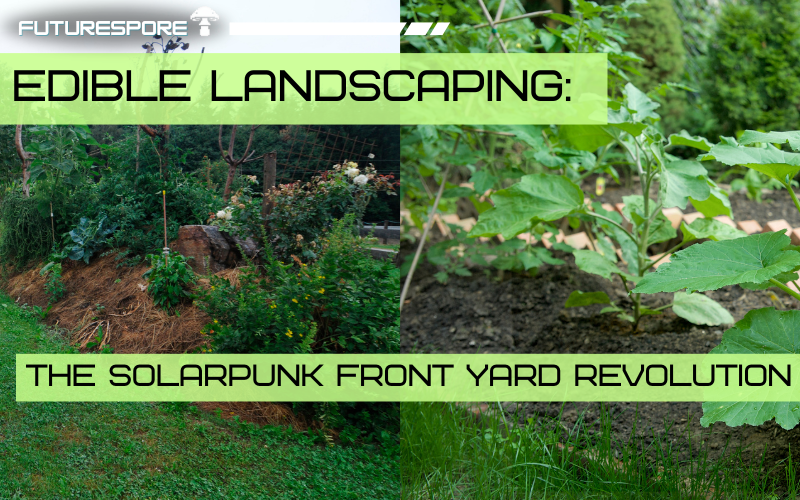
The Front Yard Has Always Been Strange
The yard we moved into came with thirty years of front lawn. The previous owners were lawn people — devout about it — and the grass out front had been kept like a showroom floor, watered and fertilized and mowed and edged on a schedule, and in all that time, as far as I can tell, never once actually used. Nobody picnicked on it. Nobody crossed it without a reason. It existed to be looked at by the neighbors and silently graded, and for almost nothing else. I spent most of my life not finding that strange. Now I cannot stop seeing it.
Consider the same strip of land planted instead with a dwarf apple tree, a serviceberry, a tier of blueberry bushes, a few rosemary cones flanking the path, and a flowering border of bee balm and yarrow. Same square footage. Same curb appeal — arguably much more. It produces a hundred pounds of food a year and asks for less of you than the lawn it replaced.
This is edible landscaping — foodscaping, some people call it. That first strange summer after I was laid off and learning to garden, I stood in a yard and asked the question that cracked everything open for me: which of these plants are edible? Edible landscaping is the version of a yard that answers yes, on purpose, to as much of that question as it can — a garden built to be looked at and also to be eaten from. Done well, it reads as a designed garden and produces like a small farm.
The Design Principles
Three rules separate edible landscaping that works from edible landscaping that looks like a hoarder’s vegetable patch.
Lead with structure. Trees, shrubs, and architectural perennials form the bones of the design. Vegetables are filler. A front yard with a serviceberry, a dwarf cherry tree, three blueberry shrubs, and a clump of bay laurel reads as a designed garden even if you tuck kale and lettuce into every gap.
Repeat plants in groups. Three blueberries together look like a planting. One blueberry next to one currant next to one strawberry looks like a collection. Plant in threes, fives, sevens. The same rule from native gardens (drift planting) applies here.
Hide the agricultural parts. A row of staked tomatoes belongs in the back. Cabbages and leeks belong behind a hedge. The ornamental edibles — rainbow chard, dinosaur kale, purple cauliflower, ornamental peppers — belong out front. People cannot object to what looks like a flower garden but happens to produce vegetables.
The Edible Backbone
Start with the long-lived structural plants. These take years to mature, so plant them first.
Small Trees
- Serviceberry (Amelanchier). Native, beautiful, edible berries, fall color. 15–25 feet.
- Dwarf apples and pears. 8–15 feet. Espalier them against a fence for tight spaces.
- Pawpaw (Asimina triloba). Native to the eastern U.S., tropical-tasting fruit, gorgeous large leaves, totally unique.
- Dwarf peaches and plums. Short-lived (15–20 years) but generous producers.
- Bay laurel. Mediterranean tree, evergreen in mild zones, culinary leaves, beautiful structural form. Not hardy through cold winters, though — in colder zones, grow it in a pot and bring it indoors before the first hard freeze.
Shrubs
- Blueberries. Acid-soil-loving, gorgeous fall color, three-season interest. Plant in groups of three different varieties for cross-pollination.
- Currants and gooseberries. Tolerant of partial shade.
- Elderberry. Wet-soil tolerant, big white flower clusters in early summer, dark berries that need cooking.
- Rosemary. Evergreen, drought-tolerant, can be pruned into formal cones for hedge-like structure.
- Highbush cranberry (Viburnum trilobum). Native, ornamental, edible.
Perennial Herbs
- Lavender, sage, oregano, thyme, chives, mint (containerized), tarragon.
The Ornamental Vegetables
Several vegetables are beautiful enough to use as ornamentals in a visible bed.
- Rainbow chard. Stems in five colors. Reads as ornamental, eats as spinach.
- Dinosaur kale (Lacinato). Deep blue-green, dramatic vertical form.
- Purple cabbage and ornamental kale. Often planted as fall ornamentals in conventional landscapes; equally edible.
- Artichokes. Massive silver-gray architectural plants. The buds are the artichokes; if you let them flower, the blooms are spectacular.
- Asparagus. The ferny summer foliage is gorgeous and reaches five feet tall.
- Scarlet runner beans. Red flowers covered in hummingbirds, edible pods and beans.
- Purple basil, opal basil. Dark-leaved varieties for color contrast.
The HOA-Proof Front Yard
If you live somewhere with an HOA or watchful neighbors, design defensively. Five practical rules:
1. Keep clean edges. A defined border between bed and lawn (or between bed and path) signals deliberate design.
2. Do not leave bare soil exposed. Mulch everything. Bare soil reads as “unfinished” or “abandoned.”
3. Hide the temporary. Tomato cages, plant supports, season-extending row covers all look like agriculture. Use them in the side yard or behind a low hedge.
4. Stagger heights deliberately. Tall in the back, medium in the middle, short in front. The same rule any good ornamental designer follows.
5. Include flowers. Every edible bed needs deliberately decorative bloomers — nasturtium, calendula, bee balm, zinnias, dahlias, native wildflowers. The flowers visually justify the rest.
A Sample Layout for a 20×30 Front Yard
Three zones:
The canopy layer (back, against the house): one dwarf apple, one serviceberry, one bay laurel as the structural backbone.
The shrub layer (middle): a drift of three blueberries; two rosemaries pruned to cones flanking the front path; a clump of native viburnum.
The herbaceous layer (front, along path and at curb): rainbow chard, dinosaur kale, ornamental peppers, parsley, thyme, lavender, bee balm, calendula. Mulch heavily between plants.
Maintenance: prune once or twice a year, mulch annually, harvest constantly. Far easier than the lawn it replaced.
What It Produces
A 600-square-foot front yard converted to edible landscaping along these lines will produce, conservatively:
- 20–60 pounds of apples from a mature dwarf tree
- 5–15 pounds of blueberries per shrub once established
- 10–20 pounds of greens (chard and kale produce all season)
- Herbs for the whole year (kitchen, tinctures, teas)
- Several pounds of berries, plus serviceberry harvest
That is before any vegetables. The same yard producing 100–200 pounds of food annually is realistic without the design ever looking like a farm.
The Solarpunk Frame
Edible landscaping is the gentlest doorway I know into the larger work — food forests, hyperlocal agriculture, the slow reweaving of a place into something that feeds the people standing on it. It asks for no new land and no one’s permission, because the front yard is already yours; you simply begin setting productive things into the same square footage, and over a few seasons the lawn loses the argument by attrition, without anyone ever having to fight it head-on.
On our lot that work is one year old and visibly unfinished. We laid mushroom compost and hardwood mulch straight over the old turf to smother the grass back and start feeding the clay-loam underneath, and we have begun setting in guilds — produce woven through edible and medicinal natives — with a paver courtyard planned someday for the center of it. I cannot show you the finished thing. I am living in the middle of it, in the messy establishing year where you have to trust the design more than the evidence in front of you.
It is the slowest revolution on offer. You plant a serviceberry, and you wait, and the waiting is most of the work — but a yard can go from answering almost nothing to that old question to answering almost everything, and I have already watched it begin to turn.
Frequently Asked Questions
What is edible landscaping?
Edible landscaping is the practice of designing the ornamental parts of a yard — front gardens, foundation plantings, hedges, lawn substitutes — to also produce food. A blueberry shrub replaces a yew. A serviceberry replaces a Bradford pear. A bed of nasturtiums and chives replaces annuals. The yard remains beautiful while quietly feeding the household.
Will my HOA let me replace my lawn with food?
Often yes, if it's designed to look intentional. HOAs typically prohibit 'weeds' and 'unkempt' yards, not edible plants. A front yard with defined edges, mulched paths, an ornamental keyhole or geometric layout, and well-pruned plants reads as a garden and rarely triggers complaints. State laws in California, Florida, Texas, and others now protect edible front-yard landscaping.
What plants make the best edible landscape?
Berry shrubs (blueberry, currant, gooseberry), small fruit trees (serviceberry, dwarf apple, persimmon), perennial herbs (rosemary, sage, lavender), Swiss chard (rainbow stems are spectacular), kale (cavolo nero looks tropical), nasturtium (edible flower and leaves), and strawberries as groundcover. All are ornamental enough to satisfy curb-appeal demands.
Is edible landscaping more work than a regular yard?
Less, after establishment. Perennial edibles (berries, fruit trees, herbs) require less weekly maintenance than a lawn — no mowing, no fertilizing, no weed-killer. Annual edibles take more attention than ornamentals but produce food in return. Most edible landscapes settle into less weekly labor than turfgrass by year three.
How much food can a front yard produce?
A well-designed 500-square-foot edible front yard can produce roughly 100 to 200 pounds of berries, herbs, salad greens, and fruit per year — enough to noticeably offset grocery bills for one household. Yields scale with intensity: an extensively planted yard produces less per square foot than a tightly managed one but requires less labor.
Written by E. Silkweaver