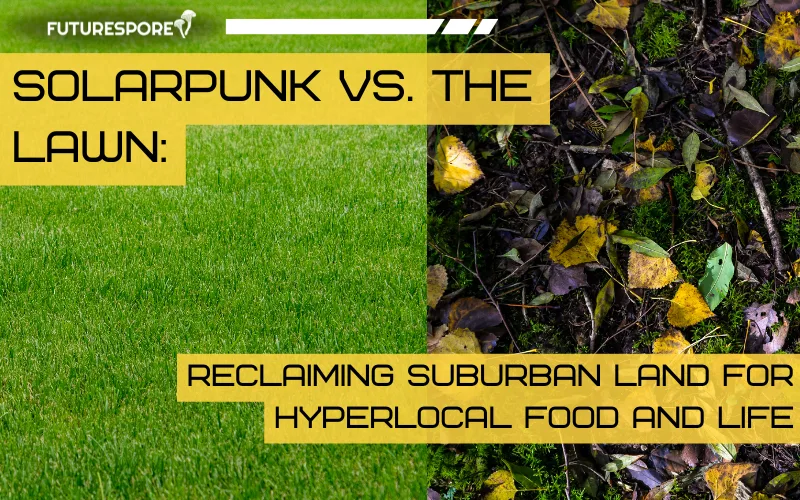
The Lawn I Inherited
The yard I am converting was a lawn for thirty years before I got the keys. The previous owners were lawn people in the dedicated sense — non-native turf grass kept clipped and green and weed-free across most of a third-acre lot, mowed weekly, fed and treated on a schedule, the kind of surface a neighborhood quietly grades you on. It is a beautiful thing in its way, and I want to be careful here, because the easy move is to sneer at it and I do not think the sneer earns anything. The people who tended this grass were not villains. They were doing exactly what the culture told them a cared-for yard looks like.
But a lawn is, ecologically, a low-diversity monoculture — a single species, held in permanent adolescence by mowing, fed by inputs, supporting very little besides itself. When I pulled up a square of the turf to see what I was working with, the grass roots stopped a couple of inches down, and below them sat rich clay-dominant loam that had been there the whole time, just suffocating under a green crust cared for as a surface and never as a living thing. The water told the same story: rain beaded on the compacted top and ran off toward the street instead of soaking in. Forty-some million acres of the United States are kept this way, the largest irrigated crop in the country, and most of it produces nothing you can eat and not much a pollinator can use. That is the diagnosis, and I am going to name it once and then move on, because the interesting part is not what the lawn fails to do. It is what the same ground will do the moment you stop fighting it.
That is the question the solarpunk frame keeps asking me — not how do I win against this landscape but what does this landscape want to become if I steward it instead of policing it. A food forest is one good answer: a layered, mostly perennial planting that grows food right where people live, feeds pollinators, holds carbon and water in the soil, and asks for less and less labor as it matures.
Killing the Lawn Without a Tiller
I did not rent a sod cutter and I did not till. Tilling would have shredded the soil biology I was trying to wake up and flipped all those dormant weed seeds into the light. Instead I am smothering the grass the slow way: a layer of mushroom compost laid straight over the turf, then a thick blanket of hardwood mulch on top. The grass underneath gets no light, breaks down in place, and feeds the very soil it dies into; the compost brings in active fungal biology and organic matter at exactly the low-phosphorus profile new plantings want. It is not instant. The first beds I sheet-mulched in the fall are still settling, and I will be honest that a few persistent runners have found the edges and tried to crawl back. But it works without a single pass of a machine, and it builds soil while it kills sod instead of destroying soil to do it.
Underneath, the clay-loam is already changing. Where the mulch has sat longest, I can pull back a handful and find white mycelium threading the chips and the leaf litter — decomposers doing the work, plus the winecap spawn I tucked into the wood chips, which are good companions in a mulched system. The compaction is loosening. The water that used to run off now has somewhere to go.
What Goes In Where the Grass Was
Into those opened beds go companion guilds — clusters of plants chosen to do work for each other rather than rows of one crop competing for the same things. I am mixing produce with edible and medicinal natives, layering the planting the way a real woodland layers itself rather than designing a tidy diagram. The structure, loosely, runs from the tallest down:
- Canopy — the big fruit and nut trees that will eventually set the upper structure and the shade everything below them tolerates. These are the longest bet on the property and the first thing I planted.
- Understory and shrubs — smaller fruit trees plus the berry bushes, currants and elderberries and the like, that are happy in the part-shade under the canopy and that start paying off years before the big trees do.
- The herbaceous and ground layers — perennial vegetables, the medicinal natives, herbs and beneficial companions, and low ground covers that shade the soil, hold moisture, and crowd out the weeds I would otherwise be pulling by hand.
- Roots and vines — tubers working the soil layer, and climbers using the vertical space the trees and trellises give them, so that almost no slice of sun or ground goes unused.
A planted square foot of this does several jobs at once where the lawn did one. The diversity manages pests that a monoculture would have to spray for. The leaf litter and the nitrogen-fixers generate fertility the system would otherwise have to buy. The deep roots and the living mulch hold water in the ground instead of shedding it to the gutter.
The Honest Timeline
I am one year in, so I will not oversell where I am. This is a conversion in progress, not a finished food forest — the trees are saplings, the guilds are barely established, a paver courtyard I have planned for the center is still just a sketch, and I have a full first summer ahead before I know what truly took. That is the real shape of it: year one is mostly roots and faith. Meaningful harvests tend to arrive around years three and four, and a planting like this keeps getting more productive and more self-sufficient as it ages, where a lawn only ever costs the same weekly mowing and watering and treating, forever, for nothing back. The maintenance curve runs the opposite direction from turf, which is the whole quiet argument. Even the seasonal upkeep gets gentler once you let the system feed itself — an autumn cleanup that returns the leaves to the soil instead of bagging them is half of what built my first beds in the first place.
I do not think everyone needs to convert their whole yard, and I am suspicious of anyone who frames this as a moral demand. But the ground under almost every lawn is patient, and it remembers how to be alive faster than you would expect. Mine is proving it one mulched bed at a time.
Frequently Asked Questions
Why does the solarpunk movement hate lawns?
Because lawns are the largest irrigated crop in the United States, consume vast water and chemical inputs, produce no food, support almost no biodiversity, and exist for status rather than function. Forty million acres of lawn produce essentially nothing. The lawn is the most efficient possible negation of solarpunk principles in landscape form.
What should I replace my lawn with?
Choose by goal: food (vegetable garden, food forest, fruit orchard), pollinator habitat (native meadow, pollinator strip), low-maintenance ground cover (clover, creeping thyme, microclover, buffalo grass), or play space (no-mow lawn alternative). Most yards benefit from a mix — a small play area surrounded by productive plantings.
Is replacing my lawn legal where I live?
Almost always yes, especially after recent state laws. California, Florida, Texas, Maryland, and others have passed legislation protecting drought-tolerant and native landscaping from HOA prohibition. Check your specific HOA covenants and municipal ordinances; design intentionally (defined edges, mulched paths) and you'll rarely face genuine problems.
How much money does a lawn cost?
The average American household spends 500–2,000 dollars per year on lawn maintenance (mowing, fertilizer, water, equipment, seed) — and 9 billion gallons of water are used on residential lawns daily nationwide. A replaced lawn typically pays back in 2–4 years through reduced inputs alone, before counting the value of food, flowers, or habitat produced.
What's the easiest first step toward replacing a lawn?
Overseed white clover into existing turf at 1 lb per 1,000 square feet. Within two seasons, clover replaces 30–60 percent of the grass, fixes nitrogen, supports bees, and stays green in drought. Cost under 30 dollars. No demolition, no permits, no plan required — the easiest possible entry to landscape transformation.
Written by E. Silkweaver, founder of Futurespore.