Trending for a Reason
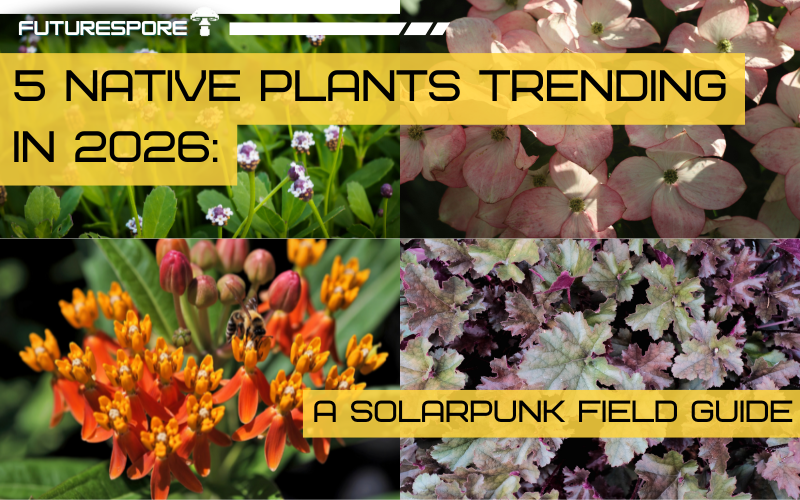
Google Trends data for North America in 2026 names five native plants as the most-searched: butterfly weed, coral bells, frogfruit, dogwood, and blue flag iris. The list is significant. These five together cover full sun to deep shade, dry to wet soil, and small ground covers to small trees. If you wanted a starter set of natives that could handle almost any yard, this would be it.
Below: a one-page profile of each, with what they actually want and what they actually do.
1. Butterfly Weed (Asclepias tuberosa)
Why it’s trending: the monarch crisis put milkweeds back in public consciousness, and butterfly weed is the most ornamental and best-behaved of the milkweed family.
What it wants: full sun, well-drained soil, no fertilizer, no babysitting. Dry-prairie native with a taproot that hates being moved.
What it does: nectars two dozen pollinator species, hosts monarchs when paired with common or swamp milkweed, blooms brilliant orange June through August. A full deep-dive lives in our butterfly weed guide.
2. Coral Bells (Heuchera spp.)
Why it’s trending: shade-tolerant native foliage plant with a hundred ornamental cultivars now widely available. People with shaded yards are tired of hostas and barberry; coral bells fills the niche.
What it wants: partial shade, average to moist well-drained soil, mulched but not mulched against the crown (which rots if buried). USDA zones 4–9 depending on species.
What it does: evergreen or semi-evergreen mound of scalloped leaves in colors ranging from chartreuse to nearly black. In late spring, sends up airy sprays of small bell-shaped flowers that hummingbirds love. The straight species (H. americana, H. villosa) hosts more native insect life than the showier cultivars; if biodiversity is your priority, start there.
One catch: many cultivars sold as “native” are heavy hybridizations bred for foliage color, with reduced pollen and seed value. The straight species or near-straight selections (like ‘Autumn Bride’ or ‘Brownie’) are the more honest pollinator choices.
3. Frogfruit (Phyla nodiflora)
Why it’s trending: drought-tolerant, deer-resistant, lawn-replacement ground cover that’s native across the southern half of the U.S. People are looking for grass alternatives, and frogfruit is one of the best.
What it wants: full sun to part shade, almost any soil including poor and compacted, drought tolerant once established. Zones 6–11. Spreads by stolons.
What it does: forms a dense, low (3–6 inch) mat that handles light foot traffic, blooms tiny clover-like white flowers spring through fall, and hosts at least four native butterfly species as a larval food plant. It can be mowed if you want a lawn-substitute look, or left unmowed for a denser bloom display.
One catch: in mild-winter zones it’s evergreen and prolific; in colder zones it dies back hard and re-emerges late. Plan accordingly. It also spreads enthusiastically — ideal in lawn-replacement contexts, less ideal interplanted with delicate perennials it might overrun.
4. Native Dogwood (Cornus spp.)
Why it’s trending: flowering tree with structural value, fall color, winter berries for birds. People are wanting natives at every scale, and dogwood is the most popular native small tree.
Which species: flowering dogwood (Cornus florida) is the iconic eastern species with white or pink bracts in spring. Pacific dogwood (C. nuttallii) is its western analogue. Red-twig dogwood (C. sericea) is a shrub form valued for brilliant red winter stems and good in wet sites. Gray dogwood (C. racemosa) is a tough thicket-former great for hedgerows.
What it wants: moist, well-drained soil, partial shade (especially for C. florida, which scorches in full sun). Mulch the root zone; don’t mow under it.
What it does: hosts at least 117 species of moth and butterfly caterpillars. The fall berries feed bluebirds, robins, and migrating thrushes. As a structural element, dogwoods give a native garden vertical bones it would otherwise lack.
One catch: flowering dogwood is susceptible to anthracnose. Plant in a site with good air circulation and don’t crowd it. Some Cornus florida cultivars are bred for disease resistance.
5. Blue Flag Iris (Iris versicolor, Iris virginica)
Why it’s trending: wet-soil native that solves the gardener’s perennial problem of “what do I plant in the boggy spot where nothing else works.”
What it wants: consistently moist to wet soil — the side of a pond, a low spot that puddles, a rain garden. Full sun to part shade. Zones 3–9.
What it does: sends up strap-like blue-green leaves in early spring and large violet-blue flowers with yellow throats in May or June. The flowers feed bumblebees and hummingbirds; the seed pods are decorative in fall.
Use it as the centerpiece of a rain garden, which we cover in detail in our rain garden guide. Pair with joe-pye weed, cardinal flower, and swamp milkweed for a stunning wet-meadow planting.
One caution: all parts of native iris are mildly toxic if ingested. Not a pet hazard at any reasonable level, but worth knowing.
The Solarpunk Frame
The fact that these five plants are the most-searched in 2026 tells me something hopeful. People aren’t just searching for “native plants” in the abstract anymore. They’re looking up specific species by name. That’s the difference between curiosity and commitment.
These five, planted together, would give you a multi-layered, four-season, ecologically functional garden in almost any yard in the eastern or central U.S. Butterfly weed in sun. Coral bells in shade. Frogfruit as ground cover. Dogwood as a small tree. Blue flag iris in the wet spot.
That’s a complete starting palette. Five plants is a garden.
Written by E. Silkweaver