A note: some book links in this post are Bookshop.org affiliate links — buying through them supports independent bookstores and earns Futurespore a small commission, at no extra cost to you.
Safety Notice
This article is for educational purposes only and is not medical or nutritional advice. Foraging and consuming wild plants carries inherent risks, including misidentification, allergic reactions, and exposure to contaminated areas. Never consume any wild plant you have not positively identified using at least two reliable sources. Some edible plants closely resemble toxic species. Consult a qualified expert or healthcare provider if you are unsure. When in doubt, leave it out.
How I Started Looking Down
I did not come to wild greens through a field guide or a course. I came to them through a question I could not put down. It was the first summer I spent paying any real attention to plants — a balcony of produce I had tried to grow, most of it eaten by the squirrels that neighbors near the highway had taken to feeding — and one evening, sitting in the yard with a friend over a socially distanced burger, I looked at all the green coming up through the cracks and thought: which of these plants are edible? Not in the abstract. These ones, right here, the ones I kept mowing and pulling and stepping over.
The way in turned out to be two apps. Seek and iNaturalist — point the phone at a leaf, get a name, follow the name down the rabbit hole. That is the whole tech-meets-nature intersection in a sentence: a camera, a database, and a person finally curious enough to crouch. And here is the thing nobody tells you at the start — most of the plants I learned to eat were not rare and were not far away. They were the weeds I had been treating as a problem.
That is most of what foraging for wild greens actually is. Not hunting something exotic in deep woods, but learning to recognize the abundance already growing at sidewalk edges, park borders, the unmowed corner of a yard. You don’t need wilderness access or expensive gear. You need a reliable way to identify what you’re looking at, the restraint to leave most of it standing, and the patience to learn one plant at a time. If greens are your first season, our spring foraging guide to early-season wild edibles is a good companion for what the warming months bring — part of the larger habit I think of as rewilding your diet, one plant and one meal at a time.
The Rules That Keep You Safe
The apps are a doorway, not an answer. A phone gives you a guess and a percentage; it does not eat the plant. So the rule I hold to, and the one I would ask you to hold to, is that nothing goes in the basket until I have confirmed it against more than the screen — a regional field guide, the distinguishing features checked one by one, and ideally a person who has eaten the thing before. Leda Meredith’s Northeast Foraging lives on my shelf for exactly this reason. Some edible greens have toxic look-alikes, and a few of those look-alikes can put you in a hospital. When you cannot get to certainty, you leave it. That is not caution for its own sake; it is the price of doing this at all.
Two more habits matter as much as identification. The first is where. Skip roadsides, old industrial ground, drainage edges, and any lawn or park likely sprayed with herbicide — a perfectly identified plant pulled from contaminated soil is still a bad idea. The second is how much. Take a fraction of what’s there, never the whole stand, and leave the roots in the ground so the patch comes back next year and the wildlife that depends on it isn’t shorted. Foraging that empties a place is just a slower kind of extraction.
For gear, you need almost nothing: a cloth bag or a breathable basket so your harvest doesn’t sweat and wilt, scissors or a small knife to cut cleanly instead of tearing, and gloves — the nettles, as you’ll see, earned their name. A notebook helps too. Writing down where you found a plant and what it was doing that week teaches you the calendar of your own neighborhood faster than any guide can.
A Handful of Greens Worth Knowing
You don’t need a long list. You need a few plants you can recognize cold, in any light, without the phone. Here are the ones I’d start a new forager on — common across temperate North America, hard to confuse with anything dangerous once you know them, and far more nutritious than what the grocery store calls salad.
Dandelion (Taraxacum officinale)
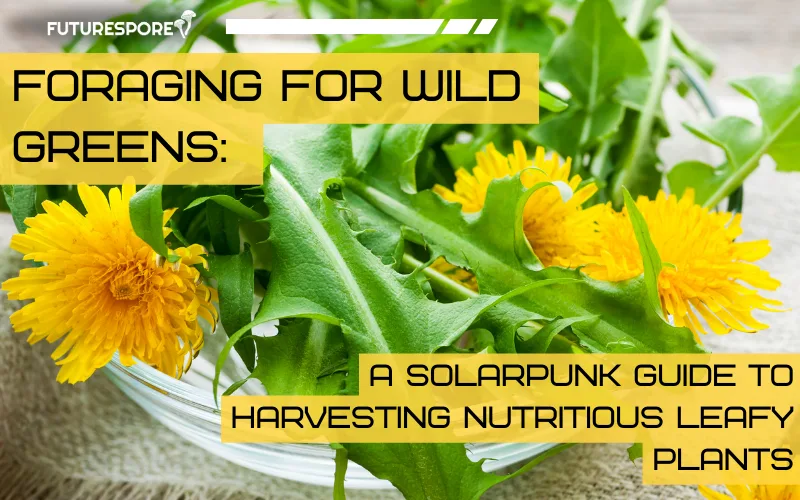
The gateway plant, and the one nearly everyone already recognizes. Every part is edible — leaves, flowers, roots. The greens run rich in vitamins A, C, and K, and in calcium and iron, and they carry a frank bitterness that the supermarket has trained most of us out of liking. That bitterness is the point and also the manageable part: pick the leaves young, before the plant flowers, or blanch them briefly, and they settle into something closer to a peppery chicory than a punishment. Roots roast into a coffee substitute; flowers fry into fritters. Harvest only from ground you know hasn’t been sprayed, which on most lawns is a real question worth asking before you bend down.
Chickweed (Stellaria media)
Where dandelion is bitter, chickweed is mild, almost sweet — a cool-season green that fills shady, damp corners while everything else is still dormant. Look for the small five-petaled white flowers that read like ten because each petal is deeply split, and for the single line of fine hairs running up one side of the stem, which switches sides at each leaf pair. That hairline is the tell that separates it from a couple of less friendly look-alikes, so learn it. Leaves, stems, and flowers all go raw into a salad or wilt down like spinach. It’s also long been used cooling, in salves for skin irritation — though that’s a topical tradition, not a medical claim.
Stinging Nettle (Urtica dioica)
Wear the gloves. Nettle stings exactly as advertised, and it does it through thin fabric, so handle it like it means it. Earn past the sting, though, and you get one of the densest wild foods there is — heavy in iron, calcium, and vitamins A and C, with a deep, dark, spinach-and-then-some flavor once cooked. Heat and drying both neutralize the sting completely; a thirty-second blanch is plenty. Harvest the young spring tops, before the plant gets tall and goes to seed, into soups, into a tea, into pesto. This is the one I’d point a tired, depleted person toward first.
Ramps (Allium tricoccum)
I want to be precise here, because this is the plant guides most often name wrong — older versions of this one included. In the eastern North American woods, the wild onion that pushes up smooth, broad, flat leaves in early spring, the one that reeks unmistakably of onion and garlic the instant you crush a leaf, is the ramp, Allium tricoccum. It is not Allium ursinum. Ursinum is the European cousin — ramsons, called wild garlic in Britain — and it does not grow wild here. They are different species, and if you forage the Appalachians you want the right name in your head.
Ramps are worth knowing for two reasons, and the second matters more than the first. The first is that they’re wonderful — leaf and bulb both, a deep sweet garlic you can’t buy. The second is that they are slow. A patch can take the better part of a decade to establish, and that spring leaf is the plant’s one window to feed itself for the whole year. Overharvested ramp colonies collapse and do not come back on any timeline that helps you. So if you take any, take a single leaf from scattered plants and leave the bulb in the ground — never dig out a patch, no matter how generous it looks. And the safety line, because it’s a serious one: ramps have toxic look-alikes. Lily of the valley and, more dangerously, false hellebore (Veratrum viride) share the same wet spring woods and have hospitalized people who mistook them. The crushed-leaf onion smell is your best confirmation — the impostors have none — but pair it with the soft, smooth leaf and the reddish lower stem before anything goes in the bag.
Purslane (Portulaca oleracea)
A summer succulent that sprawls flat across warm bare ground — gardens, sidewalk cracks, the edge of a driveway. Reddish stems, small fleshy spoon-shaped leaves, a crunch and a faint lemony tang raw. It holds more omega-3 fatty acid than any other leafy vegetable I know of, which is a strange and good thing to find growing in a sidewalk crack. Eat it raw for the texture, or cook it into soups and stews where it thickens slightly. One honest caution: purslane is high in oxalates, so go easy if you’re prone to kidney stones.
Sorrel (Rumex acetosa)
If purslane is faintly lemony, sorrel is unmistakably so — a bright, sharp, almost sour green from its oxalic acid, the kind of flavor that wakes up eggs, fish, or a heavy soup. Look for the arrow-shaped leaves in meadows and grassy edges, and take them young; older leaves turn tough and too acidic to enjoy. Because that tartness comes from oxalic acid, sorrel is another one to eat in moderation rather than by the bowlful — a seasoning green more than a base.
One Plant at a Time
You don’t learn this all at once, and you shouldn’t try. Pick one green this season — dandelion is a forgiving place to start — learn it until you could name it in the dark, cook one meal with it, and let that be enough. Next season, add another. That is how the lawn stops being a chore to mow and starts being a place that feeds you. When autumn comes and the greens fade, the same attention carries over to nuts and tree crops; our guide to foraging wild hazelnuts is where I’d send you next.
The question that started all of this for me — which of these plants in my yard are edible? — turned out to be a door, not a fact. Walk through it slowly. Identify carefully, take little, and let the place keep more than you do.
Frequently Asked Questions
What wild greens are safe to forage for beginners?
Dandelion, chickweed, lambsquarters, purslane, plantain (the lawn weed), violet, wild mustard, stinging nettle, and garlic mustard are the safest starting greens. Each is common, easy to identify, hard to confuse with anything toxic, and far more nutritious than supermarket lettuce. Most grow within fifty feet of where you're standing.
When is the best time to forage wild greens?
Early spring through early summer, when leaves are tender and bitter compounds are at their lowest. After flowering, most greens turn tough or unpalatable. Dandelion leaves are best in March, lambsquarters in May, purslane in July. Foragers harvest each species during its 4–6 week window and move to the next.
Are dandelions actually edible and worth eating?
Yes — every part of the dandelion is edible. Leaves are a peppery salad green high in vitamin A, K, and calcium. Roots roasted make a coffee substitute. Flowers fry into fritters or steep into wine. Dandelions out-nutrient spinach, are free, grow everywhere, and are the gateway forage for almost every wild-food cook.
How do I know if a wild green is safe to eat?
Use three sources to confirm identification: a regional field guide, an experienced forager or community ID (iNaturalist), and a careful look at every distinguishing feature (leaves, stem, flowers, smell, habitat). Start with the universally safe species above. Taste a tiny amount first to check for personal sensitivity. Never eat anything you cannot identify with 100 percent certainty.
What's the most nutritious wild green?
Lambsquarters (wild spinach) leads on most measures — higher in protein, calcium, and vitamin A than cultivated spinach. Stinging nettle is the densest in iron and minerals when cooked. Purslane has the highest omega-3 content of any leafy vegetable. All three are common weeds that nobody plants.
Written by E. Silkweaver, founder of Futurespore.