A note: some book links in this post are Bookshop.org affiliate links — buying through them supports independent bookstores and earns Futurespore a small commission, at no extra cost to you.
I Knew the Pictures Before I Knew the Word
Sometime before twenty twelve — back when the images were only starting to circulate, half-formed, passed around on art blogs and image boards by people who could not yet tell you what they were looking at — I kept running into the same painting. A city threaded with vines. Glass and brass and growing things sharing one frame. Solar collectors arranged like leaves up a south wall, and people who looked like they actually belonged where they were standing. Nobody had agreed on a name for it. It read as a mood more than a movement, and I tucked it somewhere in the back of my head and forgot I was holding it.
The word found the pictures later. By the time someone finally handed me the term — solarpunk — I understood I had been carrying the thing it described for the better part of a decade. That is the honest beginning of this for me: not a manifesto, but a feeling I had no language for, sitting around waiting for the language to catch up.
What Is Solarpunk?
Solarpunk is a movement — literary, artistic, architectural, and political, all at once — that imagines a future in which human technology and living systems are designed to work with each other rather than at each other’s expense. It is the deliberate opposite of the grim, sealed, screen-lit future we have been sold for forty years. Where so much of our science fiction asks how bad it gets, solarpunk asks a quieter and harder question: what would it actually look like to live well, here, inside ecological limits, without pretending those limits aren’t real?
If you have landed on this page typing what is solarpunk into a search bar, here is the shortest honest answer I have. It is a way of picturing — and then building — a world that runs on sunlight and repair instead of extraction and disposal; a world where the technology is appropriate to the task and answerable to the people and the land it serves; a world that manages, against the odds, to be beautiful. The solar is the energy and the optimism. The punk is the refusal — not of joy, but of the assumption that the future has to be ugly.
Where the Word Came From
The term is younger than the idea it names. As best anyone has traced it, solarpunk first surfaced around two thousand eight, in a blog post that wondered what might come after steampunk once gears and coal smoke stopped reading as the future — a piece remembered, more or less, as “From Steampunk to Solarpunk.” It sat quietly for a few years. Then, in the early twenty-tens, it caught: first as an aesthetic, all golden light and Art Nouveau ironwork and plants reclaiming the built world, and soon after as fiction, when a Brazilian anthology gathered some of the first stories published openly under the banner. The pictures and the writing grew up together, which is part of why solarpunk has always felt less like a genre and more like a place people were trying to get to.
The -punk is worth sitting with, because it is easy to misread. It does not borrow cyberpunk’s leather and neon. Cyberpunk did important work — it warned us, vividly, about where unchecked corporate power and runaway technology might lead, and a lot of those warnings landed. Solarpunk just picks up the question cyberpunk left on the table: all right, and then what do we build instead? The rebellion in solarpunk is hope held on purpose, which in a culture this fluent in collapse turns out to be the genuinely punk position.
What Solarpunk Stands For
Underneath the pretty images there is a fairly coherent set of commitments. Renewable, distributed energy — sun and wind and human-scale systems, owned close to the people who use them rather than piped in from somewhere far away. Regenerative land: food forests, pollinator corridors, native plantings, soil treated as something alive rather than as a surface to be mowed. Repair over replacement, and a stubborn insistence that things be built to last and be fixable. Decentralization and mutual aid — seed libraries, tool shares, the slow rebuilding of the kinds of local relationships that an extractive economy spent a century dissolving.
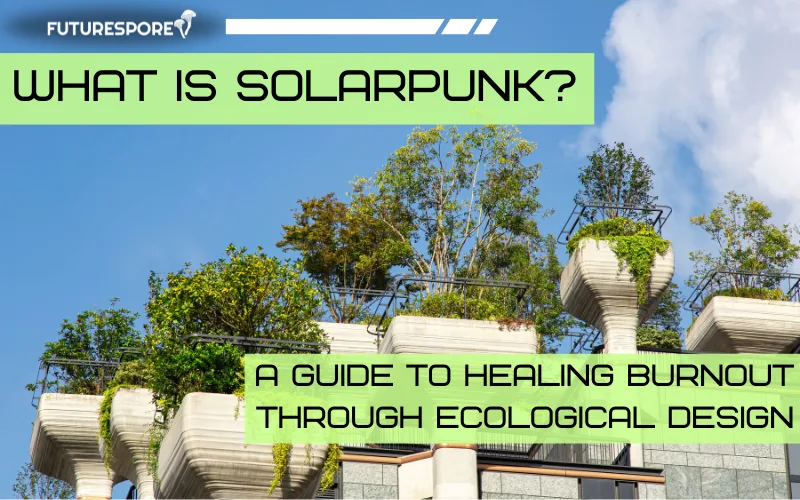
And then, threaded through all of it, beauty — not as decoration but as a requirement. Solarpunk takes seriously the idea that a sustainable world also has to be one a person would actually want to live in, which is why so much of the work happens in the realm of design and image. I have written more about that in a piece on solarpunk and the architecture of hope, and about the way good design borrows its logic from living systems in a piece on what technology can learn from nature. If you want to feel the worldview before you analyze it, the fiction is the fastest door in; I keep a running list of the best solarpunk books for exactly that reason.
The touchstones I reach for are not all labeled solarpunk, and that is the point. Studio Ghibli got here decades early — Nausicaä walking her toxic jungle, the ruined-and-blooming sky castle — and so did Biosphere 2, that gloriously imperfect experiment in sealing a few people inside a small closed world and learning, the hard way, how little we understood about the larger one we already had. I think about Kynes in Dune, the planetary ecologist quietly teaching a desert people to imagine their world green. I think about Horizon Zero Dawn, where the machines and the wilderness finally share a frame. And I think about Becky Chambers’ A Psalm for the Wild-Built, which is the gentlest argument I know that a future can be kind without being naive.
How I Actually Came to It
The pictures were the seed. The thing that made it real was twenty twenty.
In March of that year I lost my job — the company I worked for lost its access to shipping ports when the shutdowns hit, and I was one of the people that loss rolled downhill onto. I watched grocery shelves go empty in a way I had assumed, like most people my age, I would simply never see. So I became a prepper. Not in the way you might think — no bunker, no crate of ammunition, none of the survivalist iconography the word usually drags along behind it. I took the stimulus check, stepped back from the desk I had been chained to, and used the strange suspended quiet of that spring to learn, more or less, how to breathe. Prepping, for me, turned out to mean learning where food actually comes from.
That first summer I tried to grow produce on a balcony, and it was, by most measures, a failure. The squirrels — fat and fearless, fed for years by neighbors near the highway — treated my containers as a buffet and took apart nearly everything I planted. But failure has its uses. Later that season a friend came by for a socially distanced burger night in the yard, the kind of small ordinary gathering that felt enormous in that particular summer, and at some point, looking around at the green chaos at the edges of the lot, one of us asked the question that cracked the whole thing open: which of these plants in my yard are actually edible?
I did not know. And not knowing bothered me more than I expected it to. I downloaded Seek, then iNaturalist, and went down the rabbit hole — pointing my phone at every leaf within reach, learning names, learning which “weeds” were dinner and which were medicine and which would land me in the hospital. That was the intersection that has held me ever since: a piece of pocket technology aimed at the living world, each one making the other more legible. It is the most solarpunk thing I do, and I do it nearly every day.
How to Live Solarpunk — Honestly, in Progress
People want solarpunk to be a finished place: the glowing eco-village in the illustration, arrived at, complete. It isn’t. It is a practice, and like any practice it is mostly unglamorous, and it scales to whatever you actually have.
I can tell you what year one looks like, because I am standing in it. The property I am working now is roughly a third of an acre, and the people who had it before me were lawn people — thirty years of pristine, chemically maintained turf over a heavy clay-dominant loam that had been treated as a surface and never as a living thing. I am killing that lawn slowly, the patient way, under mushroom compost and hardwood mulch, and establishing companion guilds of produce woven through edible and medicinal natives, with a paver courtyard planned for the center of it. Under the mulch there is winecap spawn I am hoping will make the full loop. On the shelf inside there are tinctures in jars and a stack of botanical and pharmacological textbooks from the 1960s and 1970s. None of it is finished. The first summer’s verdict is not even in yet. That is the honest state of things, and I would rather tell you that than sell you the illustration.
If you have less than I have — and most people starting out do — the practice scales all the way down. A single container of herbs on a windowsill is solarpunk. So is learning three wild plants in the strip of green you walk past every day, or fixing the thing instead of replacing it, or moving your money to a credit union, or leaving one corner of the yard unmowed and watching what shows up. The point was never the scale. The point is the direction: toward reciprocity with the systems that keep you alive, and away from the quiet assumption that someone, somewhere, has already decided how the future has to go.
That is what the word finally meant for me — the name that arrived years after the pictures, and a decade before the yard. Not a destination. A direction, and the daily, imperfect, deeply ordinary work of facing that way.
This article is also available to read on Medium.com.
Frequently Asked Questions
What is solarpunk?
Solarpunk is a literary, design, and political movement that imagines and works toward a sustainable, just, and ecologically integrated future. It combines renewable energy, biodiversity, community, and beauty with appropriate technology. Solarpunk emerged in the early 2010s as a hopeful counter to dystopian and cyberpunk futurism.
What does solarpunk stand for?
Renewable energy, biodiversity, decentralization, food sovereignty, repair culture, integration of nature with technology, beauty in everyday life, and the rejection of extractive capitalism and dystopian fatalism. It is hope as a method — the belief that a livable future is built rather than awaited.
Is solarpunk realistic?
More realistic than the alternatives. Solarpunk doesn't require utopia — it requires a million households growing some of their own food, planting natives, retrofitting buildings, biking when possible, and repairing what's broken. None of these practices are speculative; all are returning at scale. Solarpunk is what realism looks like once we stop pretending extractive economics is stable.
How is solarpunk different from environmentalism?
Environmentalism is defensive — preserving what remains. Solarpunk is constructive — designing what comes next. Environmentalism focuses on protection and harm reduction; solarpunk focuses on regeneration and integration. They are compatible, but solarpunk has a specific imaginative and aesthetic commitment that environmentalism alone doesn't carry.
How can I be solarpunk?
Grow some food. Forage in your bioregion. Bike or take transit when you can. Repair instead of replace. Plant natives. Skip the lawn. Join (or start) a community group. Support local agriculture. Read fiction that imagines a livable future. None of this requires utopia. It requires consistent practice. Solarpunk is a verb.
Written by E. Silkweaver, founder of Futurespore.