A note: some book links in this post are Bookshop.org affiliate links — buying through them supports independent bookstores and earns Futurespore a small commission, at no extra cost to you.
The Quiet Collapse
Lawn covers something like forty million acres in the United States — the figure comes from a 2005 NASA-led satellite estimate (Milesi and colleagues) that Doug Tallamy popularized in Bringing Nature Home — and almost none of it feeds the native insects everything else depends on. North America has lost close to three billion breeding birds since 1970, about 29 percent of the total; that number is from Rosenberg and colleagues, published in Science in 2019, and habitat loss is a large part of why. Most lawns and most landscaped gardens are ecological deserts — they look green, but they support almost nothing. A typical hosta or barberry bush feeds nearly none of the native insects our food web runs on.
A native garden is the most ecologically impactful single change a homeowner or renter with outdoor access can make. Not solar panels. Not an electric car. A native garden. Doug Tallamy’s research at the University of Delaware shows that yards converted to native plantings support orders of magnitude more bird, butterfly, and insect life than conventional landscaping.
I think we are finally past the moment when planting natives seemed eccentric. People are noticing the silence. This guide is for anyone who wants to start.
What “Native” Actually Means
A native plant is one that evolved in your specific region alongside the insects, birds, and fungi of that region. “North American native” is too vague. A prairie plant from Iowa is not native to a Pennsylvania forest. A California native is not native to Florida.
The standard reference unit is the ecoregion — a geographic area defined by climate, soil, and historical plant communities. The EPA divides North America into hundreds of ecoregions. The Audubon Society has a free native plant database you can search by ZIP code, which returns plants that are native to your specific area and lists which birds and butterflies use each one.
Before you buy anything, look up your ecoregion. Then look up which plants are native to it. Don’t skip this step. A plant labeled “native” at a big-box garden center may be native to somewhere thousands of miles away.
Step One: Read Your Site
Before you plant, learn your yard. Spend a few weeks watching.
Sun. Where does direct light fall? For how many hours? Native plants are sorted into full sun (six-plus hours), part shade (three to six), and full shade (under three). Match the plant to the spot, not the other way around.
Soil. Sandy, loamy, or clay? Acid or alkaline? Cheap pH test kits cost a few dollars at any nursery. Native plants evolved to specific soil types and will struggle outside them. Many of the most spectacular natives — butterfly weed, prairie clover, little bluestem — prefer poor, well-drained soils. Trying to grow them in rich, irrigated lawn soil is why people kill them.
Moisture. Does water pool after rain? Does the soil dry out in two days? Wet meadow species (joe-pye weed, blue flag iris) want one thing. Dry prairie species want the opposite.
Existing plants. What’s already growing? Notice what’s thriving and what’s struggling. The volunteers tell you what your site wants.
Step Two: Smother the Lawn
If you’re converting lawn, don’t dig. Dig and you wake up every weed seed dormant in the soil. Smother instead.
The classic technique: cardboard layered directly over grass, soaked thoroughly, then covered with three to four inches of arborist wood chips. Mow short first. Overlap the cardboard edges generously. Leave it for two to four months, depending on how aggressive the grass is.
Plant directly through the wood chips the next season. Cut a hole in the cardboard for each plant, dig a small pocket in the dirt below, set the plant, and re-cover with chips. The cardboard will rot into the soil within a year, and the worms and mycelium below will thank you. The no-dig method works for native gardens exactly as it works for vegetable gardens — the principles are the same and I cover the details in our no-dig gardening guide.
This is roughly where I am on my own lot — year one, killing thirty years of lawn under mushroom compost and hardwood mulch, the clay-dominant loam underneath only now starting to loosen, the first companion guilds of produce and edible natives just going in. None of it is finished. I am writing this from inside the slow part.
Step Three: Plant in Drifts, Not Singles
A common mistake among new native gardeners is planting one of each species, like a botanical collection. That isn’t how plants grow in the wild and it isn’t what pollinators need.
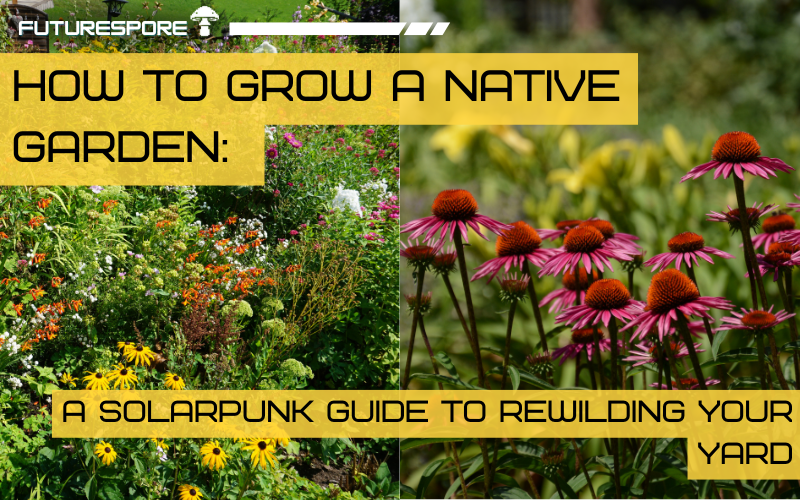
Plant in drifts — clusters of five to fifteen of the same species, repeated through the garden. A drift of nine purple coneflowers reads as a meadow patch and gives bees enough nectar in one spot to make the visit worthwhile. One coneflower lost in a sea of other species reads as a specimen and is mostly ignored.
Three layers work best:
- Ground layer (under 1 foot): wild ginger, woodland phlox, prairie smoke, creeping thyme.
- Mid layer (1–3 feet): coneflowers, black-eyed Susan, butterfly weed, native asters, bee balm.
- Tall layer (3–6 feet): joe-pye weed, ironweed, native sunflowers, switchgrass, big bluestem.
Aim for at least three blooming species per season — spring, summer, and fall — so pollinators always have food. For more on the science of attracting them, see our pollinator garden guide.
Step Four: Source Carefully
Not every plant labeled native is the same. The two things to watch for:
Local ecotype. A black-eyed Susan native to Georgia is genetically different from one native to Minnesota. Ecotype matters — local-ecotype plants are better adapted to your soil, climate, and the insects that depend on them. Buy from regional native plant nurseries when you can, not national chains. Our native plants nursery sourcing guide covers how to find them.
Neonicotinoid treatment. Many nursery plants are sprayed with systemic insecticides that persist in the plant’s tissue and kill the very pollinators the plant should support. Ask explicitly. If the answer is anything other than “no, we don’t use neonics,” walk away.
Step Five: Patience and Editing
There’s a saying among native gardeners: first year sleep, second year creep, third year leap. The roots establish underground for two years before the plants put serious energy into above-ground growth. Don’t panic in year one. The garden is happening; you just can’t see it yet.
Year three is when the garden becomes itself. Plants self-seed. Combinations you didn’t plan emerge. You’ll need to edit — pull volunteers in the wrong places, divide drifts that have spread too much, replace anything that didn’t thrive.
The goal isn’t a static design. It’s a living community that finds its own equilibrium. Your job shifts from designer to editor.
What to Tell the Neighbors
A native garden in a neighborhood of mowed lawns will look messy to people who are used to lawn aesthetics. There are a few things that help:
Keep a mowed edge. A two-foot strip of mowed grass around a wild planting reads as “intentional” rather than “neglected.” This is one of the simplest fixes for HOA-style scrutiny.
Put up a small sign. Audubon, Wild Ones, and the Xerces Society all offer free or cheap signs that identify your space as a certified pollinator habitat. This single act changes a neighbor’s read of the garden from “weeds” to “something deliberate.”
Include some traditionally pretty plants. A native garden with bee balm, cardinal flower, and coneflower still reads as a flower garden. The wildness comes from the planting style, not from sacrificing color.
The Solarpunk Frame
A native garden is the cheapest, most impactful piece of ecological restoration most people will ever do with their own hands. You’re not just planting flowers. You’re rebuilding a fragment of the food web. The caterpillars feed the chickadees. The chickadees feed the hawks. The mycelium in your soil quietly stores carbon — one of the cheapest, most durable forms of drawdown we have, and one that asks for no hardware at all.
And it’s reversible in a generation. A yard restored to native plantings today supports more biodiversity than that same yard’s parents ever saw under lawn. The land remembers. We just have to stop interrupting.
Start with one drift. Three plants of one species. See what comes.
Frequently Asked Questions
What is a native garden?
A native garden is one planted predominantly with species indigenous to your specific ecoregion — plants that co-evolved with local pollinators, birds, and soil microbes. Unlike ornamental gardens, native gardens support functional ecosystems: caterpillars feed birds, native bees pollinate specific flowers, and roots build the local soil community.
How do I find native plants for my region?
Start with the National Wildlife Federation's Native Plant Finder or your state's native plant society. Both filter by ZIP code. Visit a native plant nursery (not a big-box garden center) for region-appropriate stock. Avoid 'nativars' — heavily hybridized cultivars that look native but lack the ecological function of wild-type plants.
Why grow a native garden instead of regular ornamentals?
Because ornamentals from Europe and Asia are ecological dead zones in North America. Doug Tallamy's research found that in his mid-Atlantic region native oaks support 557 species of caterpillars (butterflies and moths), while the introduced ginkgo supports only a handful. Native plants feed insects, which feed birds, which support the entire food web. Ornamentals look pretty but do almost no work.
What are the best native plants for beginners?
Butterfly weed, purple coneflower (echinacea), black-eyed Susan, little bluestem, switchgrass, common milkweed, wild bergamot, New England aster, goldenrod, and anise hyssop. Each is widely available, easy to grow, drought-tolerant once established, and high-value for pollinators. A garden of these ten plants outperforms most ornamental designs ecologically.
Is a native garden lower maintenance than a regular garden?
After year two, substantially. Natives are adapted to local rainfall and soil — they don't need irrigation, fertilizer, or amendments. They self-seed where they want. The first year requires watering and weed management; by year three a well-designed native garden is largely self-maintaining and increasingly biodiverse.
Written by E. Silkweaver