Drought-Tolerant Grass Seed Doubled in Search
In the spring of 2026, “drought tolerant grass seed” doubled in monthly search volume in the U.S. People are watching their lawns die in summer heat waves and looking for something that won’t. The good news is the answer exists. The other good news is the answer is mostly not actually grass.
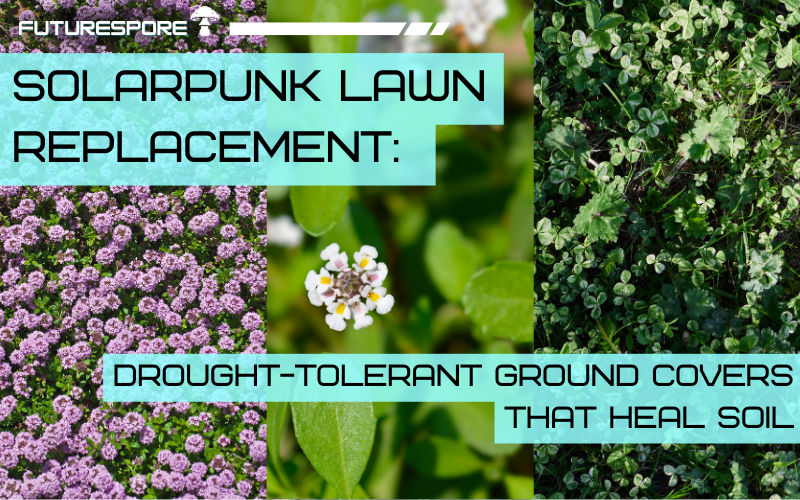
I’ve written before about why lawns are an ecological dead zone. This is the practical companion: if you’re ready to replace yours but you’re not ready to go full food forest tomorrow, here’s the middle path. Low-growing, drought-tolerant ground covers that look like a lawn, walk like a lawn, and don’t need watering or chemicals.
Why Lawns Fail in Drought
Kentucky bluegrass — the dominant species in American lawns — is a cool-season grass that evolved in a wet European climate. Its root system is shallow (typically 2 to 4 inches) and it goes dormant or dies in extended heat and drought. The deeper-rooted warm-season grasses (Bermuda, zoysia, buffalo) handle heat better but require their own concessions.
Most lawn replacement species reach deeper than turf grass — six inches to two feet — which is the entire reason they survive drought. They reach moisture turf grass can’t.
Six Lawn Alternatives Worth Knowing
1. Microclover (Trifolium repens)
White clover bred for smaller leaves and lower growth. Fixes nitrogen into the soil — meaning it fertilizes itself and its neighbors. Stays green in heat. Tolerates foot traffic. Mows well at three inches. Blooms attract bees, which some people consider a feature and some consider a bug. Honest answer: bare feet in a clover lawn occasionally encounter bumblebees. They don’t care about you. You learn this quickly.
Best for: most temperate climates, full sun to light shade. The most lawn-like substitute on this list.
2. Creeping Thyme (Thymus serpyllum)
Forms a dense aromatic mat 2 to 3 inches tall. Tolerates heat, drought, and poor soil. Tolerates light foot traffic; not for ballfields, fine for paths and small lawns. Blooms purple-pink in summer and is covered in bees while doing so. Smells like thyme when you walk on it.
Best for: full sun, well-drained soil, low-traffic lawns. Slow to establish — plant plugs rather than seed for faster cover. Zones 4–9.
3. Buffalo Grass (Bouteloua dactyloides)
A native warm-season grass of the American Great Plains. Once established, it’s the most drought-tolerant lawn grass available in North America — it survives by going gold-brown in heat, then greens up when rain returns. Roots reach down four to six feet. Mows fine, or you can leave it unmowed for a meadow look.
Best for: dry climates, USDA zones 4–8, full sun. Doesn’t love humid Southeast conditions. Slow to establish from seed; plugs are faster but more expensive.
4. Frogfruit (Phyla nodiflora)
Native ground cover across the southern half of the U.S. Forms a low mat 3 to 6 inches tall. Drought tolerant, deer resistant, salt tolerant. Blooms tiny white flowers spring through fall. Hosts at least four native butterfly species as a larval food plant. Mowable.
Best for: southern U.S., zones 6–11, full sun to part shade. See the deeper profile in our trending natives guide.
5. Sedum / Stonecrop Lawn (Sedum spp.)
Less a single plant, more a category: low-growing succulent ground covers that thrive in poor, dry soils. Various species (S. acre, S. album, S. spurium) form mats two to four inches tall. Almost never need water once established. Don’t tolerate foot traffic well — consider sedum lawns for low-use front yards or sloped areas where mowing was a struggle anyway.
Best for: dry, rocky, or thin-soil sites where regular lawn struggles. Zones vary by species; check before buying.
6. Native Sedges (Carex spp.)
Several native sedge species function as lawn alternatives, especially in shadier sites where turf grass fails. Pennsylvania sedge (Carex pensylvanica) is the most popular — it forms a soft, fine-textured mat in dry shade that needs almost no maintenance. Other species suit different conditions: C. appalachica for dry shade, C. eburnea for limestone soils, C. divulsa for sunnier dry sites.
Best for: shaded yards where lawn won’t grow. Mostly zones 4–8.
The Conversion Process
You have three options to convert a conventional lawn.
Overseed. Slowest, cheapest, lowest effort. Mow your lawn short, rake to expose soil, broadcast clover or microclover seed, water in. Over a season or two, the clover competes with the grass; if you stop watering and fertilizing, it eventually dominates. Best for transitioning to a mixed lawn rather than a full replacement.
Sheet mulch. Lay cardboard directly over the existing lawn, soak it, cover with 3 to 4 inches of arborist wood chips, wait two to four months for the grass to die underneath. Then plant plugs through the cardboard into the soil below. This is the no-dig approach; it’s what I recommend for serious conversions. Our no-dig guide covers the technique in depth.
Solarize. In sunny climates, cover the lawn with clear plastic during peak summer for six to eight weeks. The trapped heat cooks the grass and most weed seeds. Then plant. Faster than sheet mulching but uses more plastic and kills the surface soil biology.
What to Expect in Year One
Almost all lawn replacements look worse the first year than the lawn they replaced. Microclover takes a full season to fill in. Creeping thyme can take two. Buffalo grass spends most of year one building root mass underground. This is the gardening equivalent of dental work — necessary, ugly, worth it.
Year two, the new ground cover starts to look like itself. Year three, you stop thinking of it as “the replacement” and start thinking of it as your lawn.
The Solarpunk Frame
American lawns consume nine billion gallons of water a day, three million tons of fertilizer a year, and seventy million pounds of pesticides. The status they confer is increasingly hollow. The maintenance cost is real and rising. The ecological cost is total: a conventional lawn supports almost no life.
A clover lawn fixes its own nitrogen. A thyme lawn smells like Provence. A buffalo grass lawn survives a hundred-degree week without complaint. A sedge lawn doesn’t need to be mowed.
The drought tolerant grass seed people are searching for in 2026 mostly isn’t grass. It’s the realization that we’ve been doing this wrong for a hundred years, and the better option has been waiting in the wings the whole time.
Written by E. Silkweaver