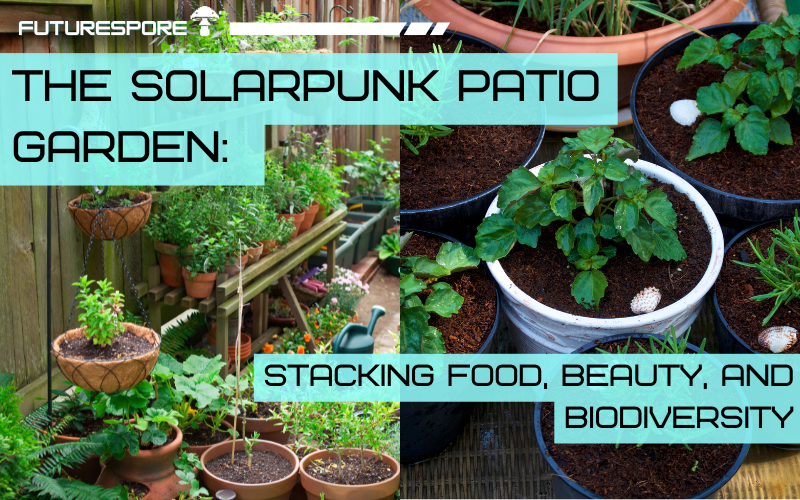
Five Feet by Five Feet
My own first garden was a balcony. Containers on a concrete slab, the spring I finally decided to learn how to grow my own food — and it did not go well. The squirrels my neighbors near the highway had taken to feeding treated the whole arrangement as a buffet laid out for them, and by midsummer there was not much left of it to harvest. I learned more from that ruined balcony than I would have from an easy first season, and most of what I learned is what this guide is built on: how big the pots need to be, where to put them, how to defend them, how to pack a small footprint without starving it.
The patio I keep returning to as the model of what a small space can actually do belongs to a friend who lives on the third floor of a brick building in a city I will not name. The patio is a concrete pad five feet by five feet, ringed by a black iron railing. She has tomatoes, two kinds of pepper, a cherry tree in a half-barrel, three pollinator containers, two trellises of climbing beans, and a wall of strawberries. She harvests something edible from it every day from May through October.
Twenty-five square feet, treated as a real growing space rather than a decorative balcony, can produce a meaningful amount of food. The trick is stacking — growing upward, layering containers, letting plants occupy different vertical zones at the same time.
This guide is the design system she uses, generalized so it works on yours.
The Patio as a Layered System
A patio garden has four available vertical zones. Most people only use one or two and wonder why their space feels cramped.
Zone 1 — the ground. Large containers, half-barrels, fabric grow bags. This is where your fruiting plants live: tomatoes, peppers, eggplant, dwarf fruit trees.
Zone 2 — tabletop and bench level. Smaller pots set on a plant stand, a sturdy bench, or a tiered baker’s rack. This is herb territory. Basil, chives, parsley, thyme.
Zone 3 — railing and hanging. Railing planters, hanging baskets, brackets mounted to the wall. Strawberries, trailing cherry tomatoes, nasturtium, pollinator pots.
Zone 4 — vertical. Trellises, a tomato cage stuffed with climbing beans, a wall of pocket planters, a stake-and-string lattice. This is the zone people forget. It is where you grow climbers, vining squash, peas, and pole beans without giving up any floor space.
When all four zones are working, the stacking does the multiplying: a five-by-five patio can grow roughly what you would expect from a flat raised bed several times its footprint, because the climbers, the railing planters, and the bench-height pots are all using vertical space a single-layer bed leaves empty.
Choosing Containers
The biggest difference between a patio garden that produces and one that struggles is container size. People consistently buy pots that are too small.
Minimum sizes:
- Tomatoes (indeterminate): 10-gallon fabric bag or 15-gallon container. Smaller and you will fight blossom-end rot all summer.
- Tomatoes (determinate, “patio” varieties): 5 gallons minimum.
- Peppers, eggplant: 5–7 gallons.
- Bush beans, salad greens: 2 gallons.
- Dwarf fruit trees: half-barrel (about 25 gallons) minimum.
- Strawberries: 1-gallon pockets work fine because their roots are shallow.
Fabric grow bags are my default for vegetables. They are cheap, they air-prune the roots — which builds a denser, healthier root system than a plastic pot does — and they fold flat once the season is over. Black absorbs heat, a gift in a cold climate and a liability in a hot one; if you are in zone 8 or warmer, reach for lighter colors.
The Companion Pot
A container garden lets you do something raised beds make harder: build each pot as its own miniature polyculture. Every large container should have a primary, a partner, and a ground cover. Three plants minimum per big pot.
Some combinations I run every year:
The Tomato Pot
- Primary: indeterminate tomato
- Partner: basil at its base (the classic culinary and growth-boosting pairing)
- Ground cover: a few nasturtium seeds (trap crop for aphids, edible flowers)
The Pepper Pot
- Primary: pepper
- Partner: marigold (deters whiteflies and aphids)
- Ground cover: oregano spilling over the edges
The Pollinator Pot
- Primary: calendula or zinnia
- Partner: dill or fennel (host plants for swallowtail butterflies)
- Ground cover: alyssum or creeping thyme
Why this matters: a single tomato plant in a single pot is a monoculture. A tomato plant with basil and nasturtium is a tiny working ecosystem. The science behind why this works — chemical signaling between roots, mycorrhizal sharing, pest confusion — is covered in our companion planting article.
Vertical: The Forgotten Zone
A six-foot trellis in a single ten-gallon pot can host four pole bean plants. Those four plants will produce a meaningful amount of green beans over two months. The container takes up the same floor space as a tomato plant, but uses air that would otherwise sit empty.
Climbers I trust on a patio:
- Pole beans — the easiest vertical crop. Plant after frost, harvest from late June through September.
- Sugar snap peas — spring and fall crop. Tolerate cooler weather.
- Cucumbers — need a sturdy trellis. Bush varieties exist if you want to skip the climbing.
- Indeterminate tomatoes — technically climbers if you stake them tall. Six-foot stakes are not too tall.
- Malabar spinach — heat-loving climbing green, beautiful purple stems.
For wall space, consider pocket planters made of felt — six to ten growing pockets stacked into a vertical wall garden. Lettuce, herbs, and strawberries all thrive in them.
The Three-Season Plan
A productive patio rotates crops through the year. The same fabric grow bag can hold lettuce in March, basil in June, and kale again in September.
Spring (March–May): peas, lettuce, arugula, radishes, spinach, cilantro. Cool-weather crops that finish before summer heat.
Summer (June–August): tomatoes, peppers, eggplant, basil, beans, cucumbers, summer squash, okra in warm zones.
Fall (September–November): lettuce returns, kale, mustard greens, more peas, garlic planted for next year.
Even in cold-winter climates, you can stretch this another month at each end with a small frost cloth and an east-facing wall.
Watering at Patio Scale
The hardest part of patio gardening is not the planting. It is the watering. Container plants in full sun dry out faster than anything in the ground — sometimes twice a day in July.
Three things help. The first is mulch — a half-inch of straw, wood chips, or even torn cardboard laid over the soil in every pot, which cuts evaporation more than any other single thing you can do. The second is company: pots huddled together make their own small weather, shading each other’s soil and holding humidity so they dry slower than a pot left standing alone. The third, if you can spare thirty dollars and an afternoon, is a simple drip system — a timer, a length of soaker hose, a few emitters — which will carry the garden through a heat wave and let you leave for a weekend without coming home to a graveyard.
The Solarpunk Frame
A patio garden is among the most realistic solarpunk acts available to a renter. You do not own the land. You cannot install a rain barrel or put a fruit tree in the ground or claim the soil under you in any permanent way. But you can sit on twenty-five square feet of concrete and turn it into an ecosystem that feeds you, brings the pollinators back, and reminds you each morning that the world is still alive.
If you keep it long enough, your patio teaches you what does not scale — industrial agriculture’s assumption that food has to come from far away. You will grow a cherry tomato that tastes better than any tomato you have ever bought. You will learn the difference between yarrow and wild carrot. You will notice when the first bee returns in spring.
That noticing is the whole project. Everything else — food forests, hyperlocal farming, the slow remaking of how cities feed themselves — starts with people who notice.
Frequently Asked Questions
How do I design a small patio garden?
Work all four vertical zones rather than just the floor: large containers at ground level, herb pots at bench height, railing planters and hanging baskets along the edge, and a trellis for climbers. Choose dual-purpose plants that earn their footprint (edible and ornamental at once), give a couple of small pots over to pollinators, and favor a few large containers over many small ones so the soil holds water through a hot day. The stacking is what lets even a five-by-five patio grow a real amount of food.
What plants work best in patio containers?
Cherry tomatoes, peppers, basil, lettuce, kale, strawberries, dwarf citrus (where climate allows), trailing thyme, nasturtiums, lavender, rosemary, and mint (always in its own pot — it will escape and dominate). Group plants with similar water needs to make irrigation simple.
How much sun does a patio garden need?
6+ hours for fruiting crops (tomatoes, peppers, strawberries), 4+ hours for leafy greens, 2+ hours for many herbs. North-facing or shaded patios still grow shade-tolerant edibles — lettuce, parsley, chives, mint, sorrel — and most native woodland plants. Match plant selection to the actual light you have, not to what you wish you had.
What's the trick to keeping patio plants alive in summer?
Larger containers (more soil mass = more water reserve), daily watering in heat, mulching the soil surface inside the container, grouping pots together to share humidity, and using drip irrigation on a simple timer if you'll be away. Most patio plant deaths happen during one missed week of summer watering.
Can a patio garden actually produce meaningful food?
Yes. Even a five-by-five patio — twenty-five square feet — with six or so large containers worked across all four vertical zones can produce most of a household's summer herbs, salad, and pollinator support, plus a meaningful amount of cherry tomatoes, peppers, and strawberries. Not all your calories, but enough to noticeably shift the grocery bill and the kitchen.
Written by E. Silkweaver