The Year I Noticed Where It Had Gone
In March of 2020 I lost the job that had organized my days, and for the first time in years there was nothing I had to refresh, nobody’s message I had to answer inside the hour. I expected to feel free. What I felt instead was a kind of withdrawal—my eyes still flicking to a phone that no longer had anything urgent to show me, my thumb still moving on its own. I had spent the better part of a decade feeding my attention into feeds that paid me back in nothing, and only when the demand stopped did I understand how much had been drawn out of me.
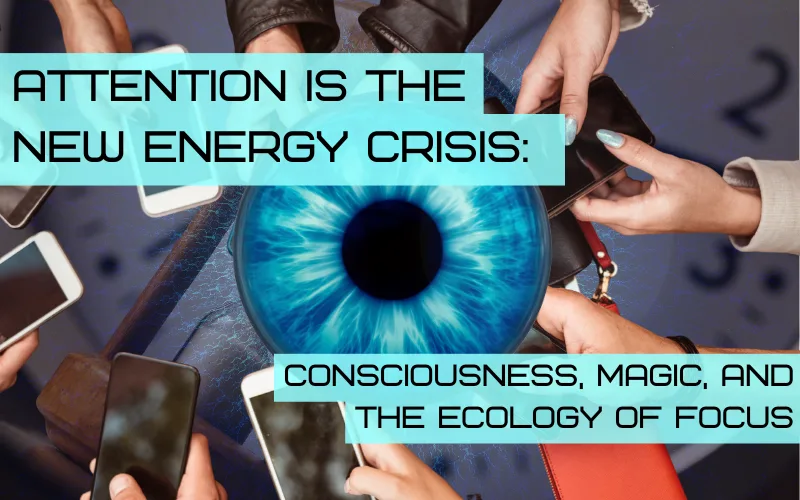
That was the spring I used the stimulus check to step away from the desk and learn, of all the basic things, to breathe again. And the more time I spent away from the screen, the clearer the shape of the problem got. Attention behaves like an energy source. There is only so much of it in a day, it can be spent well or spent poorly, and there is an entire industry whose whole business is extracting as much of yours as it possibly can—not because your focus is worthless to it, but because it is worth a great deal.
Extraction, Applied to the Mind
The parallel to fossil fuel is closer than a metaphor. A finite thing, drawn down faster than it can replenish, for someone else’s short-term profit, with the depletion treated as somebody else’s problem to feel. The average phone in the average pocket pulls four to six hours of its owner’s day, most of it given to systems engineered, query by query, to keep the next thing more compelling than the present one. I do not say this to sneer at anyone holding a phone—I was that person, and on a bad day I still am. I say it because naming the machine is the first step out of feeling like the depletion is a personal failing rather than the predictable output of a system doing exactly what it was built to do.
That is as far as I want to take the diagnosis, because the diagnosis is not the interesting part. The interesting part is that the same technology that strip-mines attention can, pointed differently, give it somewhere worth going.
The App That Pointed Me Outward
Here is the turn that surprised me. The thing that started pulling my attention back toward the living world was not deleting an app. It was downloading two—Seek and iNaturalist. I had wandered into them looking to put names to the plants coming up in my yard, and instead I fell down a rabbit hole that has not closed since. You hold the phone up to a leaf and it offers you a name; you confirm it against the structure of the plant in front of you; and the next time you pass that plant you know it, the way you know a neighbor. The screen was still in my hand. But for once it was aiming me at the ground, the hedgerow, the weeds in the sidewalk crack—not away from them.
That is the distinction I keep coming back to, and it is the one at the heart of solarpunk as a way of thinking about technology. The question is not whether a tool uses a screen. It is which direction the tool turns you. Some technology is built to hold your gaze on itself for as long as possible. Other technology hands you a name for a plant and then gets out of the way, leaving you kneeling in the dirt looking at something that was alive long before the app existed and will be alive long after.
Tending the Resource
I have come to think of attention the way I’ve learned to think of soil—something you can deplete to nothing or build back slowly, with care. Most of my own rebuilding has been unglamorous and ordinary. A morning without input before the day’s demands arrive. Hours when the phone is in another room. A walk without anything in my ears, which I resisted for an embarrassingly long time and now guard. Like the quiet work of winter dormancy, none of it looks like much from the outside, and all of it is the system quietly recovering.
I want to be honest that I am not calling any of this a regimen or a system—it is just what has worked for one person who got tired of feeling scraped hollow. What I notice, when I keep at it, is that the attention I reclaim does not stay idle. It goes back into the things that need it: the beds I’m converting, the names I’m still learning, the people in front of me, the slow business of building a future worth wanting instead of reacting to the latest thing designed to alarm me. That, more than any productivity gain, is the case for guarding your focus. It is the raw material of everything you actually care about.
Frequently Asked Questions
What is the attention economy?
The attention economy is the system in which platforms (social media, ads, streaming) compete to capture and monetize human attention, treating focus as a depletable resource to be extracted. The average smartphone user now spends 4–6 hours per day on screens; attention has become as exploited and externalized as fossil energy was in the twentieth century.
How is attention an energy crisis?
Attention is the energy of consciousness — what powers learning, creativity, relationships, and the capacity to care. When that energy is captured by extractive platforms, individuals burn out, communities fragment, and the cultural metabolism collapses. The dynamics mirror fossil-fuel extraction exactly: a finite resource overdrawn for short-term profit.
Why does focus matter so much?
Because focus is the substrate of everything else humans do well — caring for others, growing food, making art, holding political attention long enough to change a system. A society that cannot sustain focus cannot solve hard problems. The attention crisis is, downstream, every crisis.
How do I reclaim my attention?
Treat attention as energy to be conserved, not produced infinitely. Specific practices: no screens in the bedroom, mornings without input, single-tasking by default, reading print regularly, daily time outdoors without a phone, scheduled rather than reactive social media. The goal is not abstinence but sovereignty over what enters the mind.
What does solarpunk say about technology and attention?
Solarpunk distinguishes between technology that empowers (open-source tools, local AI, repairable devices) and technology that extracts (surveillance, advertising, engagement-optimized platforms). The solarpunk position on attention is the same as the solarpunk position on land: it's a commons that requires defense from enclosure. Reclaiming attention is part of the same project as reclaiming the lawn.
Written by E. Silkweaver, founder of Futurespore.