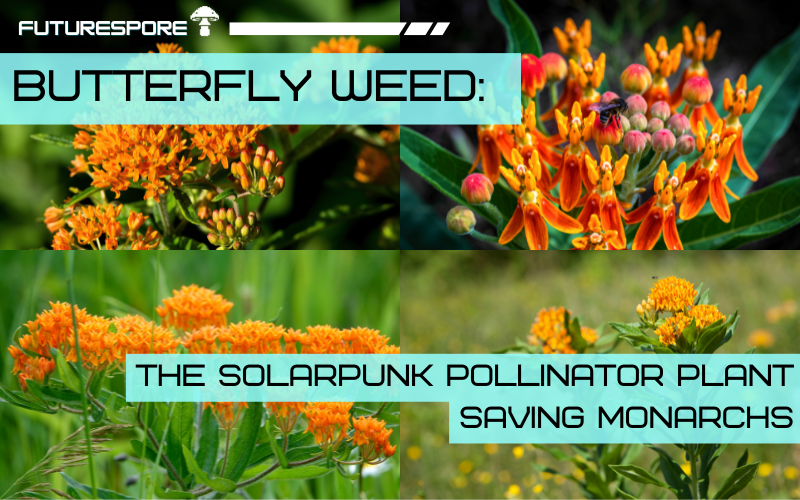
The Orange Flag in a Sea of Lawn
Butterfly weed (Asclepias tuberosa) deserves every bit of the attention it gets — there is no other native that does as much in such a small footprint: it’s a host plant for monarchs, a nectar source for two dozen other butterfly species, drought-tolerant, deer-resistant, and visible from three blocks away when it blooms.
It also happens to be one of the easiest native plants to grow if you understand what it wants. Most failures with butterfly weed are people treating it like a perennial border plant. It isn’t. It’s a dry-prairie native with a taproot that runs three feet deep. Treat it as such and it will outlive you.
Why Monarchs Need It
Monarch butterflies have suffered a roughly eighty percent decline in their eastern North American population since the 1990s. The cause isn’t mysterious: industrial agriculture and herbicide-tolerant crops have wiped out the milkweed that used to grow between corn rows. Monarchs are obligate on milkweed species — their caterpillars cannot eat anything else.
Butterfly weed is one of about a hundred milkweed species native to North America. Monarchs will lay eggs on most of them, though they prefer common milkweed (A. syriaca) and swamp milkweed (A. incarnata) for egg-laying. Butterfly weed’s role is more often as a powerful adult nectar source — its bright orange flat-topped flowers are nearly always covered in adult monarchs during summer.
In a small garden, plant butterfly weed for the adult monarchs and add a clump of swamp milkweed for the caterpillars. Together, they cover the full monarch lifecycle. For the broader design context, see our pollinator garden guide.
Plant Profile
Scientific name: Asclepias tuberosa
Native range: most of the eastern and central United States and Canada, from Quebec to Florida and west to Colorado. Multiple regional ecotypes exist; buy local if you can.
Hardiness: USDA zones 3 through 9.
Sun: full sun. At least six hours of direct light daily. It will sulk in shade and refuse to bloom.
Soil: sandy or rocky, well-drained, neutral to slightly alkaline. Hates wet feet. If your soil is heavy clay, mound it up six inches before planting or it will rot.
Size: 18 to 30 inches tall, 18 inches wide.
Bloom: brilliant orange (occasionally yellow) flat-topped clusters from June through August. Some plants rebloom in September if you cut spent stems.
Lifespan: long-lived perennial. A healthy plant can persist twenty years or more.
Growing from Seed
Butterfly weed is one of the most rewarding natives to grow from seed, but it requires cold stratification — a period of cold, moist conditions that breaks the seed’s dormancy. Skipping this step is the most common reason seeds don’t germinate.
Two ways to do it:
Winter sow. Sow seeds in a plastic milk jug or clear container with drainage holes in November or December. Leave outside through winter. The freeze-thaw cycles do the stratification for you. Germination will happen in March or April.
Refrigerator stratify. Place seeds between damp paper towels in a sealed plastic bag and refrigerate for thirty days. Then sow indoors under lights in early spring.
Either way, the seedling will spend its first year building a taproot underground while producing only a small rosette of leaves above ground. Don’t pull it because it looks wimpy. Year two, it explodes.
Transplanting Caveats
Butterfly weed develops a deep taproot from a young age, which makes it difficult to transplant once established. If you’re buying potted plants, get them in the ground as small as possible — quart-size plugs are ideal. Mature container-grown plants often go into transplant shock for a full year before they recover.
Once it’s in the ground, leave it alone. Butterfly weed does not want to be moved. Choose its forever spot the first time.
Companion Plants
Three combinations that work well in a sunny native garden:
Prairie style: butterfly weed with little bluestem grass, prairie smoke, and pale purple coneflower. Dry, low-water, structurally beautiful through fall.
Meadow style: butterfly weed with black-eyed Susan, native sunflowers, and bee balm. Loud, abundant, peak summer color.
Pollinator focus: butterfly weed with swamp milkweed (where monarchs lay eggs), wild bergamot, and a fall aster. Covers the full monarch lifecycle and nectars three seasons.
The Folk Uses
Butterfly weed has a long ethnobotanical history. Indigenous peoples across its range used the root medicinally — it was sometimes called pleurisy root for its use treating respiratory ailments. The root contains cardiac glycosides similar to those in foxglove, and is not something to experiment with as a home herbalist. The same compounds protect monarchs: caterpillars sequester the toxins from the leaves, making themselves and their adult butterflies unpalatable to predators.
Mention butterfly weed’s history in this guide more for context than for instruction — this plant’s real solarpunk usefulness is ecological, not medicinal.
The Solarpunk Frame
Plant a single drift of three butterfly weeds and within two years you will host monarchs. They will come from somewhere — some pasture edge or old prairie remnant a mile away — and they will find your three plants and use them. That’s not abstract. That is, mechanically, how the eastern monarch population is going to recover or fail to recover.
Every yard that goes from lawn to butterfly weed adds capacity. Yours is not a token gesture. It is a functioning waypoint in a continental migration that needs every waypoint it can get.
The orange flag goes up in June. The monarchs find it.
Frequently Asked Questions
What is butterfly weed and why is it important?
Butterfly weed (Asclepias tuberosa) is a native North American milkweed with bright orange flowers that monarch butterflies depend on for reproduction. Monarch caterpillars eat only milkweeds, and butterfly weed is the most garden-friendly of the genus — drought-tolerant, deer-resistant, and stunning in bloom. It is the single most impactful plant for monarch recovery.
How do you grow butterfly weed from seed?
Cold-stratify the seeds for 30 days in a damp paper towel in the refrigerator, then surface-sow in early spring after last frost. Germination takes 2–4 weeks. The plant develops a deep taproot in year one (don't transplant), flowers lightly in year two, and reaches full glory in year three. Patience is the only difficult part.
Is butterfly weed the same as common milkweed?
No. Both are milkweeds in the genus Asclepias and both feed monarch caterpillars, but they look and behave differently. Butterfly weed (A. tuberosa) is shorter, orange-flowered, and well-behaved in gardens. Common milkweed (A. syriaca) is taller, pink-flowered, and aggressively spreads by rhizome. Butterfly weed is the better choice for most home gardens.
Why is butterfly weed trending as the #1 native plant of 2026?
Because monarch populations have collapsed by over 80 percent in three decades, gardeners are responding, and butterfly weed is the rare native that combines high ecological value with garden-grade beauty. Search interest tripled between 2023 and 2026. It has become the gateway native plant — the one that converts ornamental gardeners into ecological ones.
Where should I plant butterfly weed in my garden?
In full sun, in well-drained or even sandy soil, with no irrigation once established. Butterfly weed hates wet feet and rich soil — the worse the soil, the happier the plant. Front-yard borders, gravel-edged beds, and dry slopes are ideal. Avoid mulching the crown, which can rot.
Written by E. Silkweaver