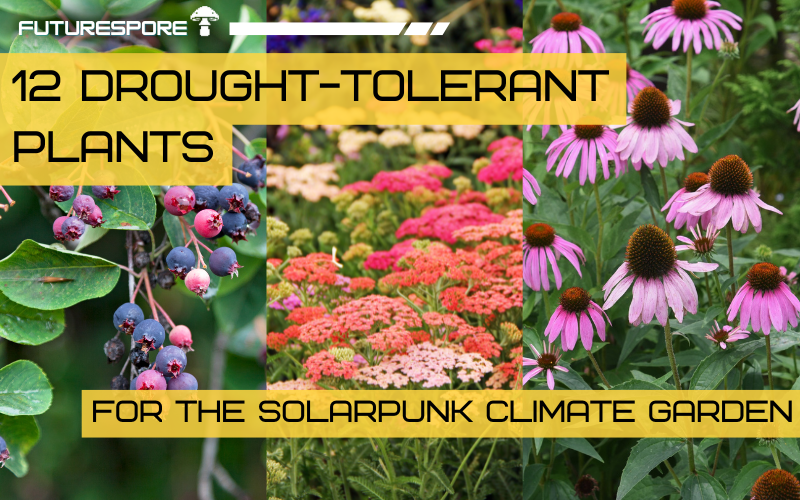
Plant for the Climate You Have
We’re past the point of pretending. Summers are hotter. Droughts are longer. The plants that filled every conventional nursery lot a few decades ago are not the plants I should be buying in 2026 — the thirsty bedding annuals and lawn-and-foundation shrubs that came with the assumption of a hose. A garden built on that assumption now needs twice the irrigation to look the same. The smart move is to plant differently.
These twelve plants are my standard palette for climate-resilient gardens in temperate North America. They’re a mix of edibles, medicinals, ornamentals, and pollinator workhorses. Each survives extended dry spells once established. Several thrive in the kind of poor, well-drained soil where everything else struggles.
Edible & Medicinal Drought Survivors
1. Rosemary (Salvia rosmarinus)
Mediterranean shrub. Once it’s in the ground in well-drained soil, it lives on rainfall. The kitchen herb that scales from a windowsill pot to a five-foot hedge. Hardy to zone 7 in the ground, zone 5 if container-grown and overwintered indoors. Bees love the blue spring flowers.
2. Lavender (Lavandula angustifolia)
Same story as rosemary: prefers poor, rocky, well-drained soil and dry summers. Hates wet feet. Prune hard in early spring. The flowers are tinctureable, edible, and beloved by every pollinator in the neighborhood. We covered lavender as a medicinal in our herbal teas guide.
3. Sage (Salvia officinalis)
Culinary sage. Drought-tolerant once established, woody perennial, evergreen in milder zones. Older plants get leggy — replace every five to seven years for best flavor, or hard-prune in early spring.
4. Thyme (Thymus vulgaris)
Same Mediterranean family, same logic — though thyme stays lower than the rest, forming a tight mat across the herb garden that takes light foot traffic. There are more species than you’d expect to choose from: creeping thyme as a lawn substitute, English thyme for cooking, lemon thyme that does double duty as ornamental and culinary.
5. Yarrow (Achillea millefolium)
Native to most of North America. Drought-tolerant, attracts beneficial insects (especially parasitic wasps that prey on garden pests), and is one of the most useful medicinal plants on the continent — styptic, anti-inflammatory, and a classic immune-supportive herb. The folk uses are covered in our tinctures guide.
Ornamental & Pollinator Drought Plants
6. Russian Sage (Perovskia atriplicifolia)
Despite the name, not a sage. Silver-leaved subshrub with airy blue-violet flower spikes from midsummer through fall. Thrives in poor soil and full sun. Bees adore it. Cut back hard in spring; treat like a perennial in colder zones, like a shrub in warmer ones.
7. Native Sedums (Sedum spp.)
These are the succulents of the temperate garden — water-storing leaves, nearly impossible to kill in dry conditions. ‘Autumn Joy’ is the classic upright form; mat-forming species (S. spurium, S. acre) work as ground covers. Their value is in the timing: those late-season flowers are a critical food source for migrating pollinators, blooming when almost nothing else is.
8. Butterfly Weed (Asclepias tuberosa)
Drought tolerant, monarch host nectar plant, brilliant orange. Native across most of the eastern and central U.S. Hates wet feet, loves poor soil, lives twenty years. Full deep-dive in our butterfly weed guide.
9. Little Bluestem (Schizachyrium scoparium)
Native warm-season prairie grass. Two to three feet tall, blue-green in summer turning copper-red in fall. Deep roots, total drought tolerance, structural value through winter. The backbone of many low-water native gardens.
10. Coneflower (Echinacea spp.)
Native perennial, drought-tolerant once established, three months of pollinator visits during bloom and a fall seed crop that feeds goldfinches. Multiple species (E. purpurea is the most common; E. pallida and E. angustifolia are more drought-tolerant prairie species).
Trees and Shrubs for Dry Sites
11. Serviceberry (Amelanchier spp.)
Small native tree, fifteen to twenty feet. White spring flowers, edible blue-purple berries in early summer (taste somewhere between blueberry and cherry), reliable orange fall color. Tolerates dry sites once established. The single best small native tree I know.
12. New Jersey Tea (Ceanothus americanus)
Native shrub, three feet tall, white flower clusters in early summer, completely drought-tolerant once established. Nitrogen-fixing root system means it improves the soil it grows in. The historical leaves were used as a black tea substitute during the Revolutionary War; the modern uses are mostly ornamental and pollinator.
The Soil Question
Most drought-tolerant plants want one thing your typical garden soil doesn’t provide: drainage. They’re adapted to poor, rocky, fast-draining soils. Plant them in lawn-amended soil that holds water and many of them will rot.
Two fixes: add coarse sand or pea gravel to the planting hole, and mound the soil up four to six inches above grade so excess water runs off. In heavy clay sites, build raised beds for these plants rather than fighting the soil.
Mulch Matters
A two-inch layer of mulch around drought-tolerant plants cuts water loss dramatically and moderates soil temperature. Wood chips are the default. For Mediterranean herbs, gravel mulch actually works better — it heats up in sun and reflects light, mimicking their native habitat.
The Establishment Window
Even drought-tolerant plants need water their first year. The deep roots that protect them long-term don’t exist yet in a one-year-old plant. Water once a week the first summer (more in extreme heat). After year one, they should manage on rainfall except in severe drought.
The Solarpunk Frame
Climate-resilient gardening isn’t doom-and-gloom adaptation. It’s aesthetic. Silver-leaved Mediterranean herbs next to airy native grasses next to orange milkweed blooms is one of the most beautiful planting palettes available, and it happens to need almost no water once it’s in. That isn’t a coincidence. The plants that evolved to thrive in marginal conditions are also the plants that hold up under stress. They were always the smarter design.
Plant for the climate you have. The garden you build that way will outlast the garden you built for a climate that’s no longer arriving.
Frequently Asked Questions
What are the best drought-tolerant plants for a climate-resilient garden?
Lavender, rosemary, sage, yarrow, echinacea, butterfly weed, sedum, agastache, Russian sage, prickly pear, native grasses (little bluestem, blue grama), and Mediterranean herbs. Each survives on rainfall alone once established, requires no fertilizer, and feeds pollinators. They are the backbone of a low-water solarpunk garden.
How do you grow plants without watering them?
Plant in fall (when rainfall does the watering), mulch deeply with wood chips, choose deep-rooted natives and Mediterranean species, and skip the lawn. Established drought-tolerant plants develop roots 3–8 feet deep within their first year, accessing groundwater long after surface soil dries. The first season requires occasional watering; after that, none.
Are drought-tolerant plants ugly?
Not anymore. Modern xeriscape design uses lavender, agastache, butterfly weed, echinacea, and ornamental native grasses to create gardens that are more colorful and longer-blooming than lawns. The 'rocks and cactus' look is one specific regional style, not the only option. A Mediterranean or prairie palette is lush, soft, and full of pollinators.
What is xeriscaping vs. drought-tolerant gardening?
Xeriscaping is a formal water-conservation landscape design system developed in Denver in the 1980s — seven principles including planning, soil improvement, mulch, and zoning. Drought-tolerant gardening is the broader practice of choosing plants that don't need irrigation. All xeriscape gardens use drought-tolerant plants; not all drought-tolerant gardens follow xeriscape principles.
When is the best time to plant a drought-tolerant garden?
Fall, in most North American climates. Cool soil, autumn rain, and dormant top growth let plants invest in deep roots before summer heat. Spring planting works but requires more first-season watering. Plants established in October are typically irrigation-free by the following July.
Written by E. Silkweaver