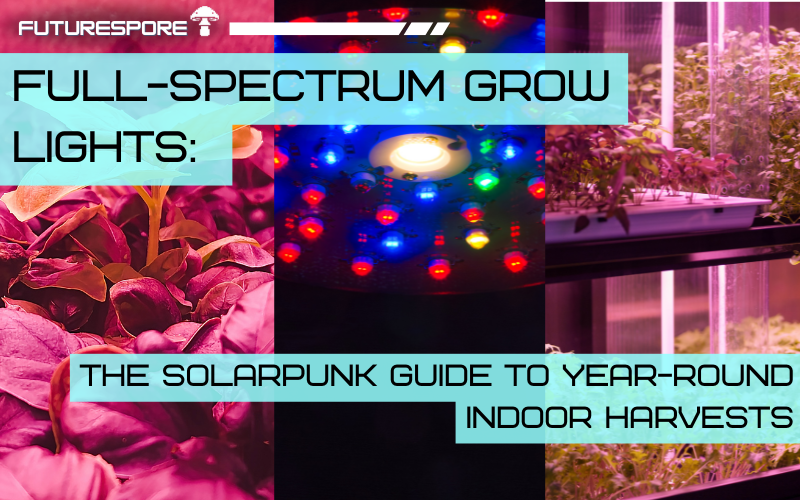
The Light Most Plants Never Get
There is a wall I run into every year in a climate with four real seasons and a winter that sets hard frost for months at a time — the light coming through a window is not enough to feed most edibles, and the cold on the other side of the glass is not negotiable. LED grow-light technology has finally gotten cheap and efficient enough to be worth reaching for.
This is a guide to choosing one without getting fleeced. The trade runs on confusing specifications and borrowed marketing language, and a good share of the price you pay is for the confusion rather than for the light. The science underneath is simpler than the catalog wants you to believe. Once you know which few numbers to read, most of the noise falls away.
The Light Plants Actually Use
Plants do photosynthesis using light between roughly 400 and 700 nanometers — the same range our eyes see as visible light. This is called PAR: photosynthetically active radiation. Within PAR, plants particularly use blue light (around 450 nm, important for vegetative growth and compact form) and red light (around 660 nm, important for flowering and fruiting).
Early grow lights used only red and blue, producing the iconic purple glow. Modern full-spectrum LEDs include green and yellow wavelengths too, mimicking sunlight. Plants actually use a small amount of green light deep within the leaf canopy, and the spectrum is gentler to look at in your home.
For practical purposes: get a full-spectrum (sometimes called “sun-spectrum” or “daylight”) LED. Skip the purple-only fixtures unless you are running a dedicated grow space.
The Number That Matters: PPFD
Lumens are useless for grow lights. Lumens measure brightness as perceived by human eyes — we are especially sensitive to green wavelengths, which plants use the least. A 10,000-lumen light might be perfect for your kitchen and useless for tomatoes.
The number that matters is PPFD: photosynthetic photon flux density, measured in µmol/m²/s (micromoles per square meter per second). PPFD tells you how many photosynthetically useful photons hit a square meter of leaf each second.
Target ranges, roughly:
- Microgreens and seedlings: 100–200 PPFD
- Leafy greens, herbs: 200–400 PPFD
- Flowering plants, fruiting vegetables: 500–1000 PPFD
- Outdoor full sun, for comparison: 1500–2000 PPFD
Good manufacturers publish PPFD readings at specific distances. The ones to avoid brag about wattage instead. If you cannot find a PPFD number on a light’s product page, that is the warning sign.
DLI: The Daily Total
PPFD is instantaneous. DLI (daily light integral) is the total light a plant receives over a 24-hour period, measured in moles per square meter per day. It is the number that decides whether a plant thrives or merely hangs on.
Most edibles want a DLI somewhere between 12 and 30. Tomatoes and peppers want the higher end. Lettuce and herbs are content at the lower.
The arithmetic is forgiving: PPFD × hours per day × 0.0036 = DLI. So 300 PPFD for 14 hours comes to roughly 15 DLI — a comfortable spot for most leafy greens.
Running lights around the clock does not help. Most plants need a dark period to respire, the same way they would in a field. Fourteen to eighteen hours is the practical ceiling for vegetative growth; twelve hours is what tips many fruiting plants into flower.
What to Buy
Three tiers, each suited to different ambitions.
The $30 Tier — A Single Shelf
For one or two plants: a clip-on full-spectrum LED gooseneck lamp, or a simple LED bar light. Look for 30–100 watts of actual power draw (not “equivalent wattage,” which is marketing). At one foot from the plants, this gives you usable PPFD for herbs, microgreens, and seedlings. Good for a single windowsill or a small grow tent.
The $100–$300 Tier — A Grow Shelf
For a serious herb-and-greens setup: a full-spectrum LED panel rated 100–200 watts. Mars Hydro, Spider Farmer, and AC Infinity are the names that come up again and again in this range — though I would still buy on the published PPFD and the honest wattage figure rather than the badge on the box. Mount it over a metal shelving unit with a few trays beneath. This is enough to grow a meaningful amount of greens, herbs, and microgreens year-round.
The $300–$1000 Tier — Fruiting Plants Indoors
For tomatoes, peppers, or anything that requires high light: a quantum-board LED panel rated 240–480 watts. This is the territory of dedicated indoor gardens. The economics here are debatable for most home growers — you can produce significant amounts of food, but the electricity costs add up. Worth it for off-season harvests in cold climates; not necessarily a replacement for summer outdoor growing.
Distance and Coverage
LED brightness drops with the inverse square of distance — doubling the distance from light to plant cuts intensity by 75 percent. Most LED panels work best 12 to 24 inches above the canopy. Closer is more intense; too close burns leaves.
Coverage area is the footprint where the light delivers usable PPFD. A 100-watt panel typically covers about 2×2 feet effectively. Do not spread a small light across a wide bed and expect serious yields — the edges will sit in shade, and the plants there will tell you so.
The Electricity Cost
A 200-watt grow light running 14 hours a day uses 2.8 kWh per day, or about 85 kWh per month. At a U.S. average of $0.15 per kWh, that is roughly $13 a month. Worth knowing before you scale up. A serious 480-watt setup running the same hours costs about $30 a month in electricity.
Compare to grocery store basil at $4 a bunch, and the math depends on how much basil you eat.
The Solarpunk Honest Take
Here is the part the product pages skip. Indoor grow lights are not a low-input solution. Even an efficient LED draws real electricity, and pretending otherwise is the kind of wishful accounting that gives solarpunk a soft reputation it does not deserve. Where they earn their keep is in a cold climate with long, frost-set winters, in an apartment with no window worth the name, or in the steady year-round production of greens and herbs. Where they do not is in raising a fruiting plant you could have grown on a sunny patio for nothing.
I do not buy the line that a grow light is unnatural. That framing has never held up for me — a greenhouse is glass and steel, a cold frame is a box and a sheet of plastic, and both have been quietly extending seasons for centuries. The work is to use the thing on purpose. To stretch a season for a plant you will actually eat. To make up for a window that genuinely cannot do the job. To weigh the embodied cost of a panel that will last a decade against the diesel cost of winter lettuce trucked in from two thousand miles away — and to notice how often the panel comes out ahead.
Pair grow lights with a south window. Use them in winter, not summer. Match them honestly to the plants and the climate you actually have.
Then go pick lettuce off the kitchen counter in February, while the yard outside is locked under frost and the trucks are still running.
Frequently Asked Questions
What is a full-spectrum grow light?
A full-spectrum grow light produces wavelengths across the photosynthetically active range (400–700 nm), usually with a little far-red and UV just outside that band — together approximating natural sunlight for indoor plants. LED full-spectrum panels have replaced older HPS and fluorescent setups because they are more efficient, run cool, and deliver tunable light recipes for different growth stages.
Are full-spectrum LED grow lights worth it for indoor gardening?
For year-round herbs, salad greens, and seedling starts, yes. A 100-watt full-spectrum LED can produce roughly one to three pounds of greens per month, depending on the crop and conditions, and modern LEDs typically draw far less electricity than the older HPS setups they replaced. For fruiting crops (tomato, pepper), you need higher-intensity panels and longer cycles, and the economics get tighter.
What's the difference between PAR and lumens for grow lights?
Lumens measure light brightness as perceived by human eyes; PAR (Photosynthetically Active Radiation) measures the wavelengths plants actually use. Plants don't care about lumens. Always shop grow lights by PPFD (photosynthetic photon flux density) and PAR coverage, not by lumens or watts. A high-lumen consumer LED is nearly useless for plants.
How long should grow lights be on each day?
Lettuce and most herbs: 14–16 hours. Seedlings: 16 hours. Fruiting vegetables (tomato, pepper): 12–14 hours. Always include a dark period — plants need night respiration to grow. A simple plug-in timer prevents the most common mistake: 24-hour lighting, which stunts plants and wastes electricity.
Can I grow tomatoes indoors with a grow light?
Yes, but it requires a serious panel (300+ watts, full spectrum), a determinate variety, hand-pollination, and adequate root space (5+ gallon container). Indoor tomatoes are possible but rarely cost-effective compared to herbs and greens. For a small indoor garden, prioritize salads, herbs, and microgreens — tomatoes are an experiment, not a workhorse.
Written by E. Silkweaver