Automating the Wrong Thing
The yard we inherited had been a lawn for thirty years — pristine, overmaintained, kept by people who clearly loved the look of the thing. I am spending this year killing it, slowly, under mushroom compost and hardwood mulch, to make room for food. So I have been watching the robotic-mower surge with a particular kind of attention. The machines have gotten cheaper and smarter, and they are suddenly everywhere — gliding across the neighbors’ yards, filling the ads — and the promise printed on the box is the one I might once have wanted myself: never mow again. The lawn tends itself.
There is a question hiding under that promise, and it is not the one the machine answers. The machine answers how to keep the lawn. The harder question is whether the lawn should be there at all.
I want to be fair to the machine. A robotic mower solves a genuine problem for a lot of people — the hour it eats every weekend, the strain on a body that cannot easily push a gas mower around a yard, the noise and the fumes. Measured against what it replaces, it is a real improvement. But a solarpunk reading does not stop at whether a thing beats what came before. The older and more useful question is whether the thing is worth doing in the first place.
The Case for Robotic Mowers
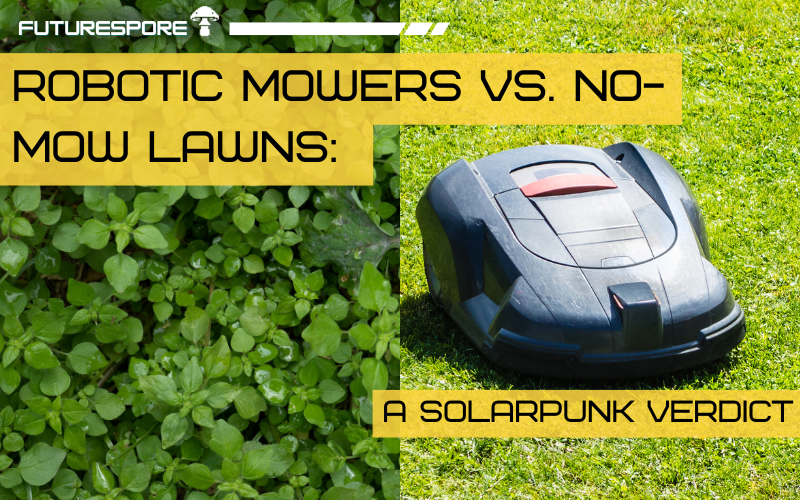
Modern robotic mowers (Husqvarna Automower, Worx Landroid, Ecovacs, Mammotion and others) work like Roombas for grass. They live in a small charging station, drift across the lawn in semi-random patterns clipping a few millimeters at a time, and return to charge.
Real advantages compared to gas mowers:
- Zero emissions in operation. Battery-electric. The electricity might come from coal depending on your grid, but no on-site exhaust.
- Quiet. Most run at 60–65 decibels — conversational volume rather than the 90–100 dB of a gas mower.
- The clippings stay on the lawn. Frequent very-light cuts mean clippings decompose immediately, returning nitrogen to the soil. Reduces or eliminates fertilizer need.
- Time recovered. An hour a week, fifty weeks a year, returned to you.
I am not anti-technology. These are real wins.
The Case Against Lawns Themselves
Then there is the thing the machine cannot touch. A monoculture grass lawn is an ecological dead zone whether you cut it with a robot or graze it down with a goat. None of the robot’s cleverness reaches a single one of the actual problems with a lawn:
- They still require irrigation in dry climates.
- They still feed almost no native insects.
- They still support no native plant communities.
- They still occupy land that could be doing something more useful.
Worse, in two specific ways:
The constant cut. Most robotic mowers run several times a week, keeping the grass cropped to a few millimeters. This ends any chance of wildflowers in a lawn — clover, violets, and self-heal cannot flower if they are cut every other day. A weekly mow at least leaves windows for the low bloomers to open and feed something. A robotic mow leaves none.
The ground-nesting toll. European studies have documented robotic mowers seriously injuring or killing ground-nesting wildlife — hedgehogs there, but the same logic carries over to the box turtles, fledgling birds, and ground-nesting bees of North America. The machines cannot see well enough to avoid them, and most of the killing happens quietly, in patterns that are hard to notice, at the dawn and dusk hours when small animals move. Newer models with object detection help. The basic problem is not solved.
The No-Mow Movement
The opposite approach is to do nothing, or nearly nothing — mow rarely or not at all, and let the lawn drift back toward something more interesting.
“No Mow May” started in the UK in 2019 as a campaign by Plantlife to encourage homeowners to skip mowing for the entire month of May, allowing low-growing flowers to bloom and feed early-season pollinators. Studies of participating yards found tenfold increases in pollinator numbers compared to mowed neighbors.
The movement has spread. Many municipalities now actively encourage No Mow May (and increasingly, No Mow Summer or Slow Mow Summer). The pushback against tidy-lawn norms is finally widespread enough to be socially defensible.
Three Middle Paths
For most yards the real choice is not as stark as a robot on one side and a wild meadow on the other. Most of the good options live in between.
1. Mow Less, Mow High
Set your mower to 4 inches. Mow every two weeks instead of weekly. This single change — doable with any mower including robotic ones if you can adjust the cutting height — transforms a lawn from a green carpet to a low meadow. Clover blooms, violets bloom, self-heal returns. The lawn looks shaggier but supports orders of magnitude more life.
2. Mowed Path Through a Meadow
Mow the perimeter and one or two paths. Let everything else go. The mowed paths read as deliberate; the unmowed sections become small meadows. Excellent for larger yards.
3. Lawn Replacement
Replace the lawn entirely with low-growing ground covers that need little or no mowing — clover, creeping thyme, native sedges, or a wild-meadow mix. This is the full solarpunk path. The details are in our lawn replacement guide.
The Verdict
If you are going to keep a lawn, a robotic mower is a real upgrade on a gas one — easier on your weekend, easier on the air, and no worse for the grass underneath. I would rather see every lawn in the country tended by a quiet electric machine than by a two-stroke engine coughing fumes into a summer morning.
But the deeper move is to ask whether the lawn needs to be there at all. A yard converted to native plantings, edible landscaping, or a no-mow meadow does not need a mower of any kind. The lithium and copper and electricity that would have gone into building and running a little robot can go instead toward something that grows.
None of this is a verdict against the technology. The machine is not the villain — the engineering is genuinely good, and that same ingenuity aimed at a living landscape would be a wonder. The question is what we hand it to do. Set a clever machine to maintaining a dead surface and you have automated the upkeep of a problem. The problem does not go away. It simply stops needing you.
Solve the underlying thing first. On my own third of an acre I am not shopping for a mower at all — I am working, slowly, under compost and mulch, toward a yard with nothing left to mow.
Frequently Asked Questions
Are robotic mowers eco-friendly?
Less harmful than gas mowers — they use about 90 percent less energy and emit no direct pollutants — but they still maintain ecological dead zones. A perfectly mowed lawn supports almost no biodiversity regardless of how the mowing happens. Automating a sterile landscape is more efficient sterility, not regeneration.
What is a no-mow lawn?
A no-mow lawn replaces high-input turfgrass with low-growing plants that don't need cutting — clover, creeping thyme, microclover, buffalo grass, sedges, or moss. Some no-mow lawns are mowed once or twice a season for tidiness; others are never mowed. They support pollinators, build soil, and require almost no maintenance.
Robotic mower vs. no-mow lawn: which is better?
No-mow wins on every ecological measure. Robotic mowers reduce harm; no-mow lawns provide active benefit — pollinator habitat, soil building, drought resilience, water savings. A robotic mower on a traditional lawn is a slight improvement; a no-mow lawn replaces the entire problem with a working ecosystem.
Is a robotic mower worth it for a normal lawn?
If you're committed to maintaining a turfgrass lawn, yes — robotic mowers are quieter, cleaner, and lower-labor than gas. But the question itself reveals the trap: paying $1,500+ to automate the maintenance of a landscape that produces nothing is the inverse of solarpunk thinking. Replace the lawn first; then the mower question vanishes.
What's the cheapest way to stop mowing my lawn?
Overseed white clover at 1 pound per 1,000 square feet in early spring or fall. Within two seasons, clover replaces most of the grass, fixes nitrogen, attracts bees, stays green in drought, and only needs mowing 2–3 times per year. Cost: under 30 dollars for a typical front yard.
Written by E. Silkweaver