Catch the Sky
A one-inch rainstorm sheds roughly six-tenths of a gallon off every square foot of roof it lands on. On a large suburban roof — three thousand square feet or so, counting the garage — that adds up to around seventeen hundred gallons in a single storm; a more typical twelve-hundred-square-foot roof still sheds close to seven hundred. Most of that water flows off impervious driveways and roofs, picks up oil and lawn chemicals, and ends up in the nearest storm drain, where it eventually pollutes a river. Meanwhile the soil two feet away from those downspouts is bone dry by August.
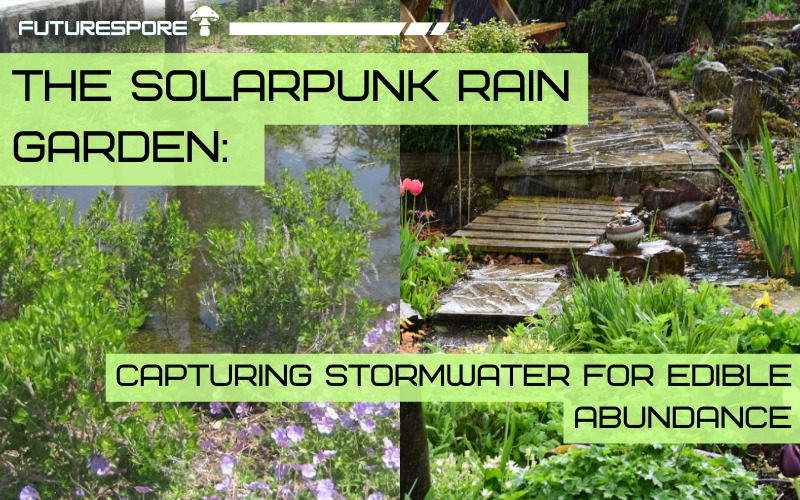
A rain garden fixes this. It’s a shallow planted depression in the lowest part of your yard, designed to receive runoff from a roof, driveway, or compacted lawn, slow it down, and let it soak into the ground over twenty-four to forty-eight hours. It recharges your soil and groundwater. It filters pollutants. It grows food.
Done well, it’s also the most beautiful corner of your yard.
How a Rain Garden Works
A rain garden is not a pond. It’s designed to hold water only briefly — long enough to absorb a storm, not long enough to breed mosquitoes (which need standing water for over a week). Three things make this work:
The depression. Four to eight inches deep across an area sized to receive the runoff from a given roof or driveway.
Amended soil. The native soil at the bottom of the depression is replaced or amended with a mix that drains faster than typical lawn soil. The goal is total drawdown of water within 24–48 hours.
Deep-rooted plants. Native plants with deep root systems (two to ten feet) that physically increase the soil’s ability to absorb water and that thrive in both flood and drought conditions.
Together, these turn a wet trouble spot into a working ecosystem.
Siting
Three rules for picking the spot:
Down-slope of a runoff source. Below a downspout, at the foot of a driveway, where a low spot already collects water during storms.
At least ten feet from your foundation. A rain garden should send water into the soil, not toward your basement.
Not over a septic system, well, or buried utility. Call your local utility-locating service (in the U.S., dial 811) before digging.
Most residential rain gardens are 100 to 300 square feet — small enough to be manageable, large enough to handle a real storm.
Sizing
The standard rule: a rain garden should be about 20 to 30 percent of the area that drains into it.
Example: a roof section of 600 square feet drains to one downspout. The rain garden serving that downspout should be 120 to 180 square feet. Larger doesn’t hurt; smaller may overflow in big storms.
Local extension offices and watershed organizations often have free rain garden calculators specific to your soil type and rainfall patterns. Use them if available.
The Three Zones
A rain garden has three distinct planting zones, each with a different water profile.
Zone 1 — the basin. The lowest center, where water actually pools. Plants here must tolerate both wet feet during storms and dry conditions in between. Blue flag iris, cardinal flower, swamp milkweed, joe-pye weed, sedges.
Zone 2 — the slope. The transition between the basin and the rim. Wet sometimes, dry mostly. Black-eyed Susan, monarda, native ferns, switchgrass.
Zone 3 — the rim. The upland edge. Essentially a normal native garden, mostly dry. Coneflowers, little bluestem, butterfly weed, native asters.
Many of the same plants from our trending natives guide work in rain gardens — blue flag iris in zone 1 is the iconic centerpiece.
Building One
A weekend project for most home-scale rain gardens.
- Mark the shape. Use a hose laid on the ground to outline a kidney or teardrop shape oriented across the slope.
- Dig the depression. 4 to 8 inches deep at the center, with gradual slopes up to the rim. Save the soil — you’ll use most of it on the downhill berm.
- Build a berm. Pile the excavated soil on the downhill edge to create a low wall that holds water in until it soaks down.
- Amend the soil. Mix the bottom 6 inches with about 30% compost and 20% coarse sand to improve drainage. Test by filling with water; it should drain within 24–48 hours.
- Plant. Set out plants by zone. Use plugs or quart-size natives in a denser planting than you would in a normal bed — about one plant per square foot. Dense planting outcompetes weeds and roots faster.
- Mulch. Two inches of shredded hardwood mulch (not bark nuggets, which float in heavy rain). Don’t mulch the very bottom of the basin.
- Connect to source. Direct the downspout or driveway runoff into the rain garden via a buried pipe, a riverbed of stones, or a simple swale.
Edible Possibilities
Most rain garden guides skip the edible angle. A solarpunk rain garden shouldn’t.
Several edible and medicinal plants thrive in zone 1 wet conditions:
- Elderberry (Sambucus canadensis) — the wet-soil shrub equivalent of a swiss army knife. Flowers and berries for syrups, tinctures, jams.
- Sweet flag (Acorus calamus) — a striking, aromatic foliage plant for wet sites. Worth noting because you’ll see it sold as a traditional medicinal: do not ingest it. The common diploid form contains β-asarone, and the FDA bans Acorus calamus as a food additive. Grow it for the strap-like leaves and the structure, not the apothecary.
- Marsh marigold (Caltha palustris) — early-spring edible greens, cooked only.
- Bog rosemary, lingonberry, cranberry — if your soil is acidic and wet.
In the upland zone, almost any drought-tolerant edible from our climate garden guide works.
Maintenance
Year one needs the most attention: water during dry spells while plants establish, hand-pull any weeds before they go to seed, and monitor the inlet for clogs.
After year one, a rain garden is one of the lowest-maintenance plantings on your property. Cut perennials back in late spring (not fall — standing stems shelter overwintering bees). Top up mulch every year or two. Watch for sediment buildup at the inlet during heavy storms; rake it out.
Most well-built rain gardens look established by year three and need almost nothing.
The Solarpunk Frame
A rain garden is the answer to both halves of the climate problem at once. It captures water during floods and stores it for droughts. It replaces lawn with habitat. It cuts your dependence on irrigation. It demonstrates — visibly, to anyone walking past — that water doesn’t have to be wasted, that yards can hold rather than shed.
Multiply by every house on the street and you’ve rebuilt the watershed. That math is real. Cities like Portland and Philadelphia are subsidizing rain gardens for exactly this reason. Your yard is part of an infrastructure your municipality can’t replace cheaply enough to ignore — a place where the water that used to run off and pollute a river instead soaks down and grows something.
Frequently Asked Questions
What is a rain garden?
A rain garden is a shallow depression planted with deep-rooted natives and positioned to capture runoff from roofs, driveways, or downspouts. The water soaks slowly into the soil rather than running into storm drains. Rain gardens recharge groundwater, reduce flooding, filter pollutants, and produce significant flowering habitat — all from runoff that would otherwise be lost.
How do you build a rain garden?
Dig a shallow basin (4–8 inches deep) at least 10 feet from your foundation, sized roughly 20–30 percent of the contributing roof or paved area. Direct a downspout or drainage path into it. Plant deep-rooted natives — joe-pye weed, swamp milkweed, blue flag iris, switchgrass, cardinal flower — that tolerate both flooding and drought.
What plants work best in a rain garden?
Plants that tolerate occasional flooding and occasional drought: joe-pye weed, swamp milkweed, blue flag iris, cardinal flower, switchgrass, little bluestem, New England aster, bee balm, button bush, sweetspire. The center of the basin (wettest zone) gets the most flood-tolerant species; the edges get the drought-tolerant ones.
How big should a rain garden be?
Roughly 20–30 percent of the contributing impervious surface (roof, driveway). A 500-square-foot roof drains to a 100–150-square-foot rain garden. Deeper basins handle more water in less footprint but require more digging. Most residential rain gardens range from 50–200 square feet.
Will a rain garden attract mosquitoes?
No, if designed correctly. A properly built rain garden drains within 24–48 hours — much faster than the 7–10 days mosquitoes need to breed. The deep-rooted plantings and rapid infiltration prevent standing water from lingering. Poor drainage (compacted clay, undersized basin) can create mosquito habitat — design and amend soil to avoid this.
Written by E. Silkweaver