Overview
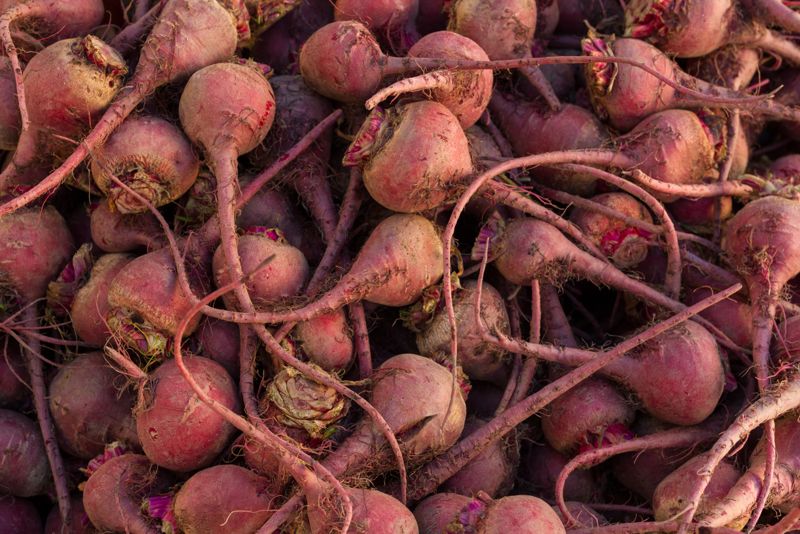
An ancient root vegetable domesticated from wild sea beet along European coastlines, prized for both its sweet, earthy roots and nutritious greens. Beets come in a rainbow of colors — deep crimson, golden, candy-striped Chioggia, and white — each with subtle flavor differences. They are one of the highest natural sources of dietary nitrates, which support cardiovascular health.
Growing Conditions
How to Grow Beet
Beet (Beta vulgaris) is a forb/herb that grows to about 2 feet tall and 1 foot wide.
Beet is hardy across USDA hardiness zones 3–11. Plant it in deep, loose, well-drained soil free of rocks, at a slightly acidic pH of 6–7.5.
Exact sowing, transplanting, and harvest months shift by climate zone — the planting calendar below lays them out for cool through hot regions. Its flowers appear from June through September. Give it what it asks for here, and it will find its place in the garden.
Companion Planting & Soil
Beet grows well alongside lettuce, onion, garlic, kohlrabi, and cabbage — but keep it clear of pole bean and mustard.
Good Companions
Avoid Planting Near
Planting Calendar
When to sow, transplant, and harvest by growing zone.
| Zone | Action | Months | Notes |
|---|---|---|---|
| Cold (1-2) | Direct Sow | May — Jun | Direct sow after soil reaches 50°F; thin to 3" apart |
| Cold (1-2) | Harvest | Jul — Sep | Harvest at 1-3" diameter; greens edible anytime |
| Cool (3-4) | Direct Sow | Apr — Jul | Direct sow 2-3 weeks before last frost; succession sow every 3 weeks |
| Cool (3-4) | Harvest | Jun — Oct | Harvest at 1-3" diameter; greens edible anytime |
| Moderate (5-7) | Direct Sow | Mar — May | Direct sow in spring; succession sow every 3 weeks |
| Moderate (5-7) | Direct Sow | Aug — Sep | Fall sowing for autumn harvest |
| Moderate (5-7) | Harvest | May — Jun | Spring-sown harvest |
| Moderate (5-7) | Harvest | Oct — Nov | Fall-sown harvest |
| Warm (8-9) | Direct Sow | Feb — Mar | Sow in late winter/early spring before heat |
| Warm (8-9) | Direct Sow | Sep — Nov | Fall through early winter sowing |
| Warm (8-9) | Harvest | Apr — May | Harvest before summer heat |
| Warm (8-9) | Harvest | Nov — Jan (wraps) | Fall-sown harvest |
| Hot (10+) | Direct Sow | Oct — Feb (wraps) | Cool-season crop; sow fall through winter |
| Hot (10+) | Harvest | Dec — Apr (wraps) | Harvest during cool season |
Uses
In the Kitchen
In the kitchen, beet turns up in more than one form: roasted, pickled, or raw in salads; greens sautéed like chard or spinach; juiced for earthy, sweet beverages.
Medicinal & Folk Use
In herbal and folk tradition, it has been valued in several ways: high in dietary nitrates supporting blood pressure and circulation; betalain pigments provide anti-inflammatory and detox support; rich in folate, manganese, and iron. These are traditional uses, not medical advice.
Beyond the Garden
Beet earns its keep past the plate, too: natural dye producing pink and red tones; historically used to make sugar (sugar beet).
The Field Library
Books from the Futurespore shelf that go deeper on plants like this one.
- Northeast Foraging region-tuned wild food guidance with clear lookalike warnings
- Braiding Sweetgrass reframes growing and gathering as a relationship of reciprocity
These are Bookshop.org affiliate links — they support independent bookstores and earn Futurespore a small commission at no extra cost to you. Browse the full Futurespore Bookshelf.