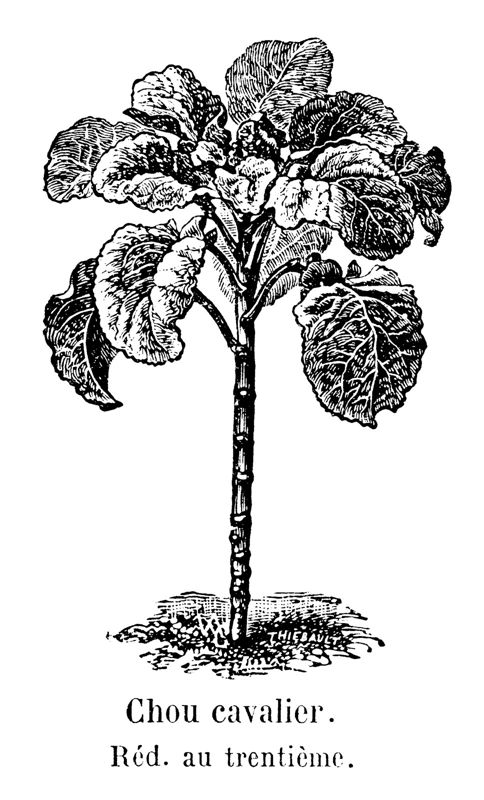
 Thiébault & VAC = Vilmorin-Andrieux & Compagnie / Public domain · Source
Collard greens
Brassica oleracea var. acephala
Overview
A cornerstone of Southern American and African cuisine, collard greens are among the most nutritionally dense leafy vegetables available. These large, sturdy brassica leaves can withstand both summer heat and winter cold better than most greens, often sweeting after frost. Collards have a deep cultural significance, with continuous culinary traditions stretching from West Africa through the African American South.
Growing Conditions
How to Grow Collard greens
Collard greens (Brassica oleracea var. acephala) is a biennial forb/herb that grows to about 3 feet tall and 2 feet wide.
To grow collard greens, give it full sun, though it tolerates a little shade. It is hardy across USDA hardiness zones 3–11. Plant it in rich, moist, well-drained soil with plenty of nitrogen, at a slightly acidic pH of 6–7. It does best with even, moderate watering.
Exact sowing, transplanting, and harvest months shift by climate zone — the planting calendar below lays them out for cool through hot regions. Its flowers appear from February through September, offering moderate value to pollinators. Give it what it asks for here, and it will find its place in the garden.
Companion Planting & Soil
Collard greens grows well alongside onion, garlic, tomato, marigold, and thyme — but keep it clear of strawberry.
Good Companions
Avoid Planting Near
Planting Calendar
When to sow, transplant, and harvest by growing zone.
| Zone | Action | Months | Notes |
|---|---|---|---|
| Cold (1-2) | Start Indoors | Mar — Apr | Start indoors 6-8 weeks before last frost |
| Cold (1-2) | Transplant | May — Jun | Transplant after last frost; very cold hardy |
| Cold (1-2) | Harvest | Jul — Oct | Harvest lower leaves; flavor improves after frost |
| Cool (3-4) | Direct Sow | Apr — May | Direct sow in spring; also midsummer for fall crop |
| Cool (3-4) | Direct Sow | Jul — Jul | Summer sow for fall harvest |
| Cool (3-4) | Harvest | Jun — Nov | Pick lower leaves; freeze sweetens flavor |
| Moderate (5-7) | Direct Sow | Mar — Apr | Spring sowing |
| Moderate (5-7) | Direct Sow | Jul — Aug | Fall sowing; frost sweetens leaves |
| Moderate (5-7) | Harvest | May — Dec | Harvest outer leaves continuously |
| Warm (8-9) | Direct Sow | Aug — Oct | Fall planting; grows through winter |
| Warm (8-9) | Harvest | Oct — Mar (wraps) | Harvest through winter |
| Hot (10+) | Direct Sow | Sep — Nov | Fall/winter crop; tolerates light frost |
| Hot (10+) | Harvest | Nov — Mar (wraps) | Harvest during cool months |
Uses
In the Kitchen
In the kitchen, collard greens turns up in more than one form: slow-braised with smoked meat in Southern tradition; chopped into soups, stews, and beans; used as a wrap substitute for grain-free eating.
Medicinal & Folk Use
In herbal and folk tradition, it has been valued in several ways: one of the richest sources of vitamin K; high in calcium and iron for bone health; glucosinolates support detoxification pathways. These are traditional uses, not medical advice.
Beyond the Garden
Collard greens earns its keep past the plate, too: cold-hardy garden green that produces through mild winters.
The Field Library
Books from the Futurespore shelf that go deeper on plants like this one.
- Northeast Foraging region-tuned wild food guidance with clear lookalike warnings
- Braiding Sweetgrass reframes growing and gathering as a relationship of reciprocity
These are Bookshop.org affiliate links — they support independent bookstores and earn Futurespore a small commission at no extra cost to you. Browse the full Futurespore Bookshelf.