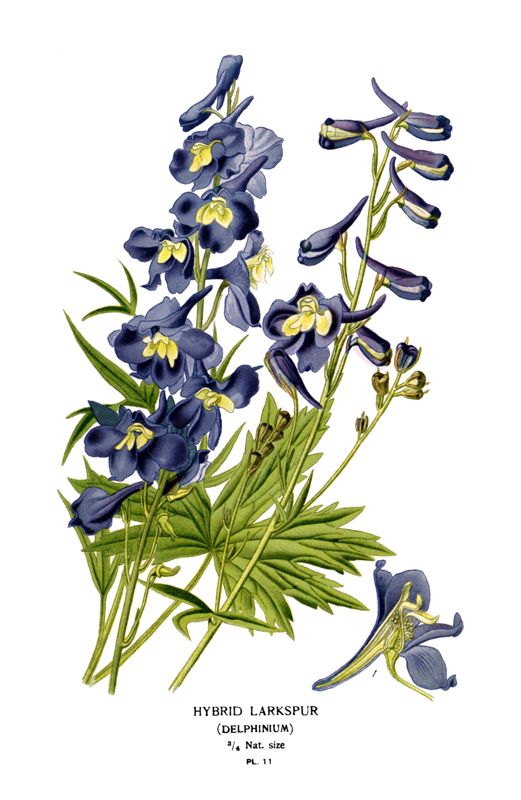
 Edward Step / Public domain · Source
Larkspur
Delphinium ×burkei
Overview
Tall, elegant spikes of spurred flowers in brilliant blues, purples, pinks, and whites that bring vertical drama to cottage gardens and cutting beds. Larkspur is the annual cousin of delphinium, easier to grow and more heat-tolerant. All parts are toxic (containing delphinine alkaloids), so handle with care — but their beauty and stature as cut flowers are unmatched among annuals.
Growing Conditions
How to Grow Larkspur
Larkspur (Delphinium ×burkei) is a forb/herb that grows to about 3 feet tall and 1.5 feet wide.
Larkspur is hardy across USDA hardiness zones 4–8. Plant it in rich, well-drained, slightly alkaline soil, at a near-neutral pH of 6.5–7.5.
Exact sowing, transplanting, and harvest months shift by climate zone — the planting calendar below lays them out for cool through hot regions. Its flowers appear from July through August, offering high value to pollinators. It keeps its own chemistry; read the safety notes before any part reaches a plate.
Companion Planting & Soil
Larkspur grows well alongside cosmos, bachelor button, and zinnia.
Good Companions
Planting Calendar
When to sow, transplant, and harvest by growing zone.
| Zone | Action | Months | Notes |
|---|---|---|---|
| Cold (1-2) | Direct Sow | Apr — May | Direct sow early spring; needs cold to germinate — refrigerate seed 2 weeks |
| Cold (1-2) | Harvest | Jun — Jul | Cut when lower third of florets open; poisonous — not edible |
| Cool (3-4) | Direct Sow | Mar — Apr | Direct sow in early spring; self-sows reliably |
| Cool (3-4) | Direct Sow | Sep — Oct | Fall sow for earliest spring bloom |
| Cool (3-4) | Harvest | May — Jul | Harvest spikes for cut flowers or drying |
| Moderate (5-7) | Direct Sow | Sep — Nov | Fall sow for spring flowers; needs winter chill |
| Moderate (5-7) | Harvest | Apr — Jun | Spring bloom; fades in summer heat |
| Warm (8-9) | Direct Sow | Oct — Nov | Fall sow only; needs cool season to establish |
| Warm (8-9) | Harvest | Feb — Apr | Early spring bloom |
| Hot (10+) | Direct Sow | Nov — Dec | Late fall sow for late winter bloom |
| Hot (10+) | Harvest | Jan — Mar | Winter/early spring bloom |
Uses
Beyond the Garden
Larkspur earns its keep past the plate, too: stunning tall cut flower in blues and purples; cottage garden and wildflower meadow planting; dried flowers retain color beautifully.
Safety Notes
All delphiniums are seriously poisonous — diterpenoid alkaloids in every part, most concentrated in seeds and young growth; larkspur is a significant livestock killer in the American West. Keep children away from the seed pods and never eat any part.
The Field Library
Books from the Futurespore shelf that go deeper on plants like this one.
- The Resilient Gardener growing staple food through drought, flood, and hard seasons
- Braiding Sweetgrass reframes growing and gathering as a relationship of reciprocity
These are Bookshop.org affiliate links — they support independent bookstores and earn Futurespore a small commission at no extra cost to you. Browse the full Futurespore Bookshelf.