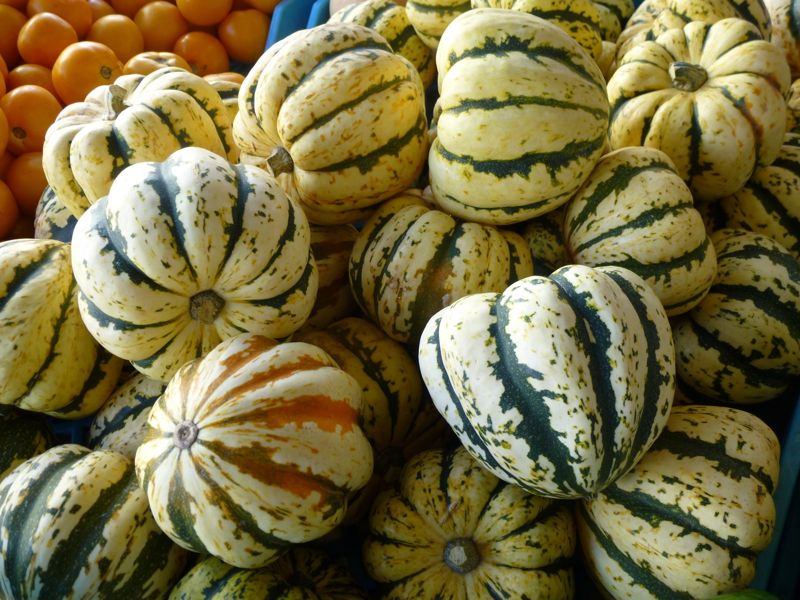
Acorn squash
Cucurbita pepo var. turbinata
Overview
A winter squash prized for its sweet, nutty flesh and distinctive ridged shape. Native to the Americas, acorn squash has been cultivated by Indigenous peoples for thousands of years as part of the Three Sisters planting tradition. Its compact size makes it ideal for individual servings and small-space storage.
Growing Conditions
How to Grow Acorn squash
Acorn squash (Cucurbita pepo var. turbinata) is a vine that grows to about 1.5 feet tall and 7 feet wide.
To grow acorn squash, give it full sun. It is hardy across USDA hardiness zones 3–11. Plant it in rich, well-drained loam with plenty of compost, at a slightly acidic pH of 6–6.8. It does best with even, moderate watering.
Exact sowing, transplanting, and harvest months shift by climate zone — the planting calendar below lays them out for cool through hot regions. The details above are a starting point — your ground will teach you the rest.
Companion Planting & Soil
Acorn squash grows well alongside corn, beans, nasturtium, marigold, and sunflower — but keep it clear of potato and fennel.
Good Companions
Avoid Planting Near
Planting Calendar
When to sow, transplant, and harvest by growing zone.
| Zone | Action | Months | Notes |
|---|---|---|---|
| Cold (1-2) | Start Indoors | Apr — May | Start indoors 3-4 weeks before last frost; use peat pots |
| Cold (1-2) | Transplant | Jun — Jun | Transplant after last frost; needs 85-100 days |
| Cold (1-2) | Harvest | Sep — Sep | Harvest when rind is dark green and hard; leave 2" stem |
| Cool (3-4) | Direct Sow | May — Jun | Direct sow when soil is 60°F+; hills 4-6 feet apart |
| Cool (3-4) | Harvest | Aug — Oct | Harvest before hard frost; cure 1-2 weeks in sun |
| Moderate (5-7) | Direct Sow | May — Jun | Direct sow after last frost; 3 seeds per hill |
| Moderate (5-7) | Harvest | Aug — Oct | Harvest when rind resists fingernail scratch |
| Warm (8-9) | Direct Sow | Mar — Apr | Direct sow in spring |
| Warm (8-9) | Harvest | Jun — Aug | Harvest when dark green with orange patch on bottom |
| Hot (10+) | Direct Sow | Feb — Mar | Sow in early spring; also late summer for fall crop |
| Hot (10+) | Direct Sow | Aug — Aug | Late summer sowing for fall harvest |
| Hot (10+) | Harvest | May — Jun | Spring crop harvest |
| Hot (10+) | Harvest | Nov — Dec | Fall crop harvest |
Uses
In the Kitchen
In the kitchen, acorn squash turns up in more than one form: roasted and stuffed with grains or sausage; pureed into soups and bisques; cubed and added to curries and stews.
Medicinal & Folk Use
In herbal and folk tradition, it has been valued in several ways: high in beta-carotene for eye and immune health; good source of potassium and magnesium; fiber-rich for digestive support. These are traditional uses, not medical advice.
Beyond the Garden
Acorn squash earns its keep past the plate, too: dried shells used as decorative bowls; seeds can be roasted like pumpkin seeds.
The Field Library
Books from the Futurespore shelf that go deeper on plants like this one.
- Edible Wild Plants a photographic guide organized by season — good for checking an ID twice in the field
- The Resilient Gardener growing staple food through drought, flood, and hard seasons
These are Bookshop.org affiliate links — they support independent bookstores and earn Futurespore a small commission at no extra cost to you. Browse the full Futurespore Bookshelf.