Borage
Borago officinalis
Overview
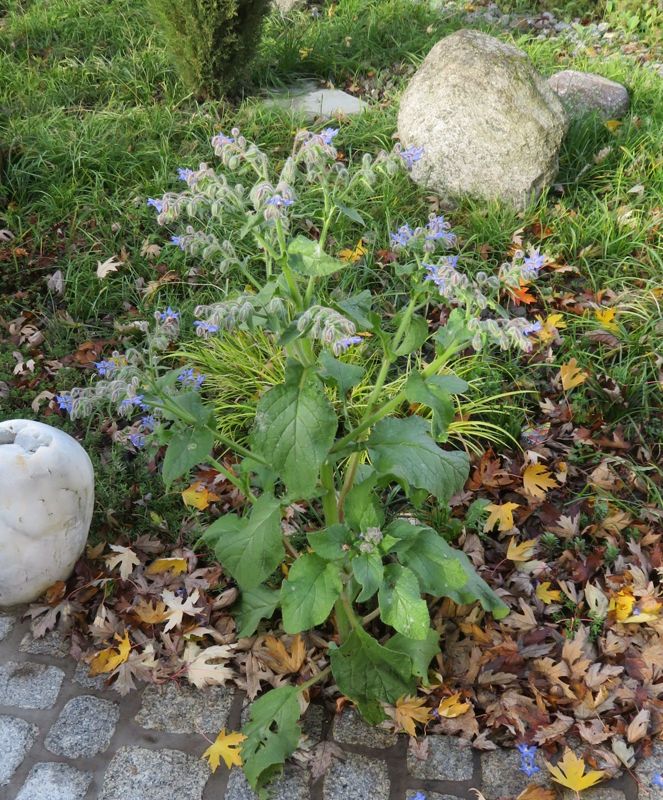
A cheerful herb with brilliant blue star-shaped flowers that taste like cucumber, borage has been called the herb of courage since Roman soldiers ate it before battle. Its drooping clusters of flowers are among the best bee plants in the garden, producing copious nectar throughout the growing season. Every part of the plant is useful — leaves, flowers, and oil-rich seeds.
Growing Conditions
How to Grow Borage
Borage (Borago officinalis) is an annual forb/herb that grows to about 2 feet tall and 1.5 feet wide.
To grow borage, give it full sun. It is hardy across USDA hardiness zones 3–10. Plant it in average, well-drained soil; tolerates poor soils, at a slightly acidic pH of 6–7. It does best with dry, sharply drained conditions.
Exact sowing, transplanting, and harvest months shift by climate zone — the planting calendar below lays them out for cool through hot regions. Its blue flowers appear from May through August, offering high value to pollinators. Give it a season to establish, and it carries itself through the dry stretches.
Companion Planting & Soil
Borage grows well alongside tomato, squash, strawberry, and cabbage.
Good Companions
Planting Calendar
When to sow, transplant, and harvest by growing zone.
| Zone | Action | Months | Notes |
|---|---|---|---|
| Cold (1-2) | Direct Sow | May — Jun | Direct sow after last frost; does not transplant well due to taproot |
| Cold (1-2) | Harvest | Jun — Aug | Harvest young leaves and blue star-shaped flowers; cucumber flavor |
| Cool (3-4) | Direct Sow | Apr — Jun | Direct sow in spring; self-sows prolifically |
| Cool (3-4) | Harvest | May — Sep | Pick flowers for salads; leaves best when young |
| Moderate (5-7) | Direct Sow | Mar — May | Sow in spring; excellent bee plant and companion for tomatoes |
| Moderate (5-7) | Harvest | Apr — Oct | Harvest flowers and young leaves continuously |
| Warm (8-9) | Direct Sow | Feb — Mar | Sow in late winter/spring |
| Warm (8-9) | Direct Sow | Sep — Oct | Fall sowing for mild winter gardens |
| Warm (8-9) | Harvest | Mar — May | Harvest before summer heat |
| Warm (8-9) | Harvest | Oct — Dec | Fall harvest |
| Hot (10+) | Direct Sow | Oct — Nov | Fall sow; grows through cool season |
| Hot (10+) | Harvest | Nov — Mar (wraps) | Harvest during cool season |
Uses
In the Kitchen
In the kitchen, borage turns up in more than one form: flowers frozen in ice cubes for cocktails and punches; young leaves added to salads for cucumber flavor; flowers candied as cake and dessert decorations.
Medicinal & Folk Use
In herbal and folk tradition: seed oil rich in gamma-linolenic acid (GLA) for skin health. These are traditional uses, not medical advice.
Beyond the Garden
Borage earns its keep past the plate, too: top-tier bee and pollinator plant; dynamic nutrient accumulator for compost; companion plant that deters tomato hornworm.
Safety Notes
Contains pyrrolizidine alkaloids (cumulative liver damage): enjoy the flowers and an occasional young leaf, but do not eat borage leaves regularly or drink borage-leaf tea. The pressed seed oil is free of the alkaloids.
The Field Library
Books from the Futurespore shelf that go deeper on plants like this one.
- The Modern Herbal Dispensatory a working reference for tinctures, salves, and doses once you get serious
- Northeast Foraging region-tuned wild food guidance with clear lookalike warnings
- Braiding Sweetgrass reframes growing and gathering as a relationship of reciprocity
These are Bookshop.org affiliate links — they support independent bookstores and earn Futurespore a small commission at no extra cost to you. Browse the full Futurespore Bookshelf.