Thyme
Thymus vulgaris
Overview
A low, aromatic herb that has been used since ancient Egypt for embalming, by Greeks as temple incense, and by Romans to purify rooms. Thyme's essential oil (thymol) is one of nature's most powerful antiseptics — it is the active ingredient in Listerine mouthwash. In the garden, creeping thyme varieties make beautiful, fragrant, walkable ground covers between stepping stones.
Growing Conditions
How to Grow Thyme
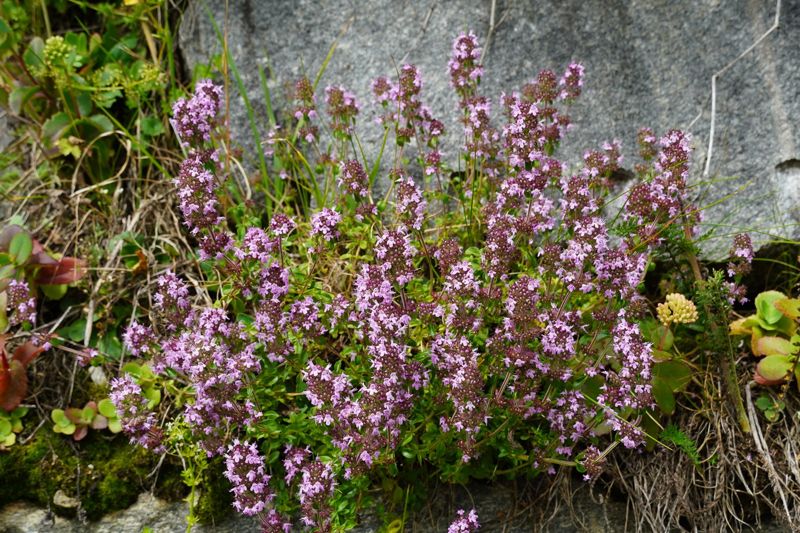
Thyme (Thymus vulgaris) is a perennial subshrub that grows to about 12 inches tall and 12 inches wide.
To grow thyme, give it full sun. It is hardy across USDA hardiness zones 4–9. Plant it in well-drained, lean, sandy or rocky soil; drought-tolerant, at a near-neutral pH of 6–8. It does best with even, moderate watering.
Exact sowing, transplanting, and harvest months shift by climate zone — the planting calendar below lays them out for cool through hot regions. Its flowers appear from July through September, offering high value to pollinators. Give it a season to establish, and it carries itself through the dry stretches.
Companion Planting & Soil
Thyme grows well alongside tomato, eggplant, cabbage, rose, and strawberry.
Good Companions
Planting Calendar
When to sow, transplant, and harvest by growing zone.
| Zone | Action | Months | Notes |
|---|---|---|---|
| Cold (1-2) | Transplant | Jun — Jun | Plant after last frost; perennial to zone 5 |
| Cold (1-2) | Harvest | Jun — Sep | Harvest sprigs as needed; best before flowering |
| Cool (3-4) | Transplant | May — May | Plant after last frost |
| Cool (3-4) | Harvest | May — Oct | Harvest sprigs as needed |
| Moderate (5-7) | Transplant | Apr — May | Plant in spring |
| Moderate (5-7) | Harvest | Apr — Nov | Harvest sprigs as needed |
| Moderate (5-7) | Divide | Mar — Apr | Divide every 3-4 years in early spring |
| Warm (8-9) | Transplant | Mar — Apr | Plant in early spring |
| Warm (8-9) | Harvest | Mar — Nov | Harvest year-round in mild winters |
| Warm (8-9) | Divide | Feb — Mar | Divide every 3-4 years |
| Hot (10+) | Transplant | Feb — Mar | Plant in late winter |
| Hot (10+) | Harvest | Jan — Dec | Harvest year-round |
Uses
In the Kitchen
In the kitchen, thyme turns up in more than one form: essential in French, Mediterranean, and Caribbean cuisine; key ingredient in bouquet garni and herbes de Provence; lemon thyme for fish, chicken, and tea.
Medicinal & Folk Use
In herbal and folk tradition, it has been valued in several ways: thymol is a powerful natural antiseptic and antifungal; traditional cough and bronchitis remedy (thyme tea); antimicrobial properties support immune health. These are traditional uses, not medical advice.
Beyond the Garden
Thyme earns its keep past the plate, too: creeping varieties as fragrant walkable ground cover; bee and pollinator plant when flowering; drought-tolerant edging and rock garden plant.
Safety Notes
Culinary use is safe. Thyme essential oil is highly concentrated — never internal; avoid medicinal doses in pregnancy.
The Field Library
Books from the Futurespore shelf that go deeper on plants like this one.
- Medicinal Herbs: A Beginner's Guide the friendliest on-ramp to growing and using healing herbs at home
- The Forager's Harvest identification, harvest windows, and preparation from someone who eats what he teaches
- Gaia's Garden home-scale permaculture — guilds, food forests, and beds that tend themselves
These are Bookshop.org affiliate links — they support independent bookstores and earn Futurespore a small commission at no extra cost to you. Browse the full Futurespore Bookshelf.