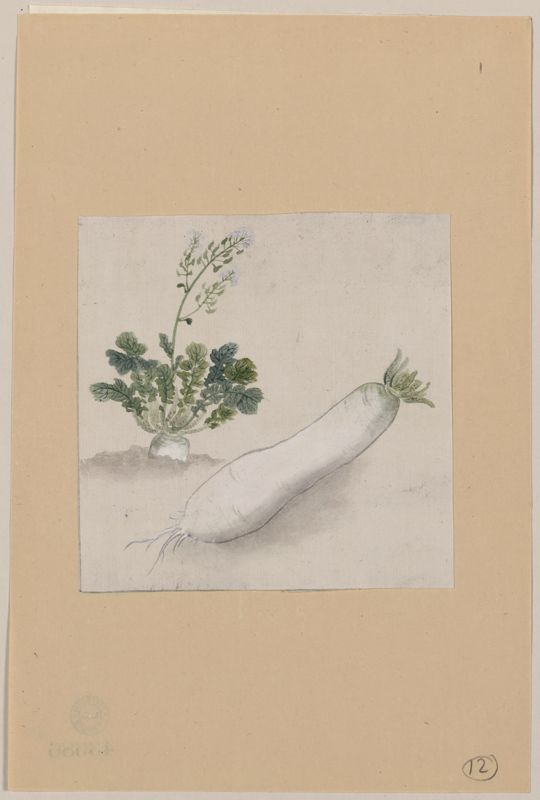
 Japanese fine prints, pre-1915 / Public domain · Source
Daikon
Raphanus sativus var. longipinnatus
Overview
A large, mild white radish that is a staple across East Asian cuisines and one of the most useful cover crop radishes for soil improvement. Daikon can grow 12-18 inches long, acting as a biological plow that breaks through compacted soil layers. Japanese varieties bred for eating are milder and crisper than the 'tillage radish' types grown purely for soil aeration.
How to Grow Daikon
Plant it in deep, loose, well-drained sandy loam, at a slightly acidic pH of 5.8–7.
Exact sowing, transplanting, and harvest months shift by climate zone — the planting calendar below lays them out for cool through hot regions. Match it to the right spot, and the rest is mostly patience.
Companion Planting & Soil
Daikon grows well alongside lettuce, carrot, pea, and spinach — but keep it clear of hyssop.
Good Companions
Avoid Planting Near
Planting Calendar
When to sow, transplant, and harvest by growing zone.
| Zone | Action | Months | Notes |
|---|---|---|---|
| Cold (1-2) | Direct Sow | Jul — Jul | Sow midsummer for fall harvest; bolts in spring |
| Cold (1-2) | Harvest | Sep — Oct | Harvest before hard freeze; roots can reach 18" |
| Cool (3-4) | Direct Sow | Jul — Aug | Best as fall crop; direct sow in late summer |
| Cool (3-4) | Harvest | Sep — Nov | Harvest before hard freeze |
| Moderate (5-7) | Direct Sow | Aug — Sep | Sow in late summer/early fall; avoid spring sowing (bolts) |
| Moderate (5-7) | Harvest | Oct — Dec | Harvest before ground freezes |
| Warm (8-9) | Direct Sow | Sep — Oct | Fall sowing; needs 50-60 days to maturity |
| Warm (8-9) | Harvest | Nov — Jan (wraps) | Harvest during cool months |
| Hot (10+) | Direct Sow | Oct — Nov | Sow in fall for cool-season growth |
| Hot (10+) | Harvest | Dec — Feb (wraps) | Harvest during winter |
Uses
In the Kitchen
In the kitchen, daikon turns up in more than one form: grated raw for sashimi accompaniment and salads; pickled as takuan in Japanese cuisine; simmered in soups and oden (Japanese hot pot).
Medicinal & Folk Use
In herbal and folk tradition, it has been valued in several ways: digestive enzyme support from myrosinase; traditional use for respiratory congestion; low-calorie source of vitamin C and potassium. These are traditional uses, not medical advice.
Beyond the Garden
Daikon earns its keep past the plate, too: cover crop variety ('tillage radish') breaks compacted soil; green manure when left to decompose in place.
The Field Library
Books from the Futurespore shelf that go deeper on plants like this one.
- The Forager's Harvest identification, harvest windows, and preparation from someone who eats what he teaches
- Gaia's Garden home-scale permaculture — guilds, food forests, and beds that tend themselves
These are Bookshop.org affiliate links — they support independent bookstores and earn Futurespore a small commission at no extra cost to you. Browse the full Futurespore Bookshelf.