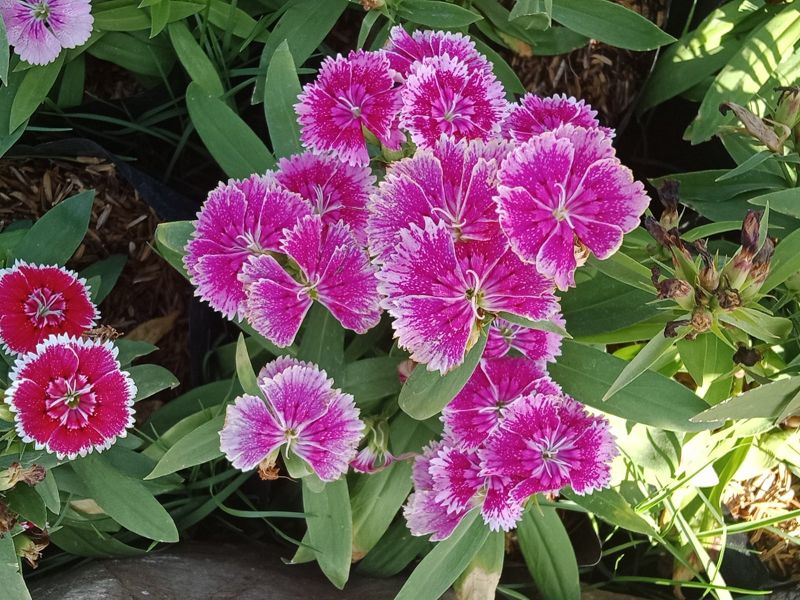
Dianthus
Dianthus spp.
Overview
The pinks, carnations, and sweet williams of the Dianthus genus have been cultivated since the time of the ancient Greeks, who named them dianthus — 'flower of the gods.' Their spicy-sweet clove fragrance is unmistakable, and many varieties are edible, with petals tasting of clove and nutmeg. These tough, drought-tolerant perennials and biennials are perfect for rock gardens, borders, and containers.
Growing Conditions
How to Grow Dianthus
Dianthus (Dianthus spp.) is a forb/herb that grows to about 2 feet tall and 1.5 feet wide.
Dianthus is hardy across USDA hardiness zones 5–9. Plant it in well-drained, slightly alkaline, gritty soil, at a near-neutral pH of 6.5–7.5.
Exact sowing, transplanting, and harvest months shift by climate zone — the planting calendar below lays them out for cool through hot regions. Its flowers appear from June through September, offering moderate value to pollinators. Give it what it asks for here, and it will find its place in the garden.
Companion Planting & Soil
Dianthus grows well alongside lavender, sage, thyme, and alyssum.
Good Companions
Planting Calendar
When to sow, transplant, and harvest by growing zone.
| Zone | Action | Months | Notes |
|---|---|---|---|
| Cold (1-2) | Start Indoors | Feb — Mar | Start indoors 8 weeks early; or direct sow after last frost |
| Cold (1-2) | Transplant | May — Jun | Transplant after last frost; perennial types hardy to zone 3 |
| Cold (1-2) | Bloom | Jun — Aug | Summer bloom; deadhead for rebloom; spicy fragrance |
| Cool (3-4) | Transplant | Apr — May | Plant in spring; well-drained alkaline soil; full sun |
| Cool (3-4) | Bloom | May — Jul | Late spring/summer bloom; shear back after first flush |
| Moderate (5-7) | Transplant | Mar — Apr | Plant in spring; clove-scented; excellent edging plant |
| Moderate (5-7) | Bloom | Apr — Jun | Spring bloom; many varieties rebloom if sheared |
| Warm (8-9) | Transplant | Sep — Oct | Fall planting for cool-season bloom; fades in summer heat |
| Warm (8-9) | Bloom | Oct — Apr (wraps) | Fall through spring bloom; dormant in summer |
| Hot (10+) | Transplant | Oct — Nov | Fall planting; cool-season performer |
| Hot (10+) | Bloom | Nov — Mar (wraps) | Winter bloom; heat shuts down flowering |
Uses
In the Kitchen
In the kitchen, dianthus turns up in more than one form: petals added to salads, cakes, and cocktails for clove flavor; historically used to flavor wine and vinegar; candied petals as dessert decoration.
Beyond the Garden
Dianthus earns its keep past the plate, too: classic cottage garden and rock garden perennial; fragrant cut flowers with excellent vase life; border and edging plant with neat mounding habit.
Safety Notes
Petals only, from plants you grew yourself — nursery bedding plants are often treated with non-food pesticides.
The Field Library
Books from the Futurespore shelf that go deeper on plants like this one.
- Northeast Foraging region-tuned wild food guidance with clear lookalike warnings
- Braiding Sweetgrass reframes growing and gathering as a relationship of reciprocity
These are Bookshop.org affiliate links — they support independent bookstores and earn Futurespore a small commission at no extra cost to you. Browse the full Futurespore Bookshelf.