 George Chernilevsky / Public domain · Source
Daylily
Hemerocallis spp.
Overview
Despite the name, daylilies are not true lilies but incredibly resilient perennials whose individual flowers each last just one day — but a single plant can produce dozens of buds for weeks of continuous bloom. Nearly all parts are edible and have been eaten in Chinese cuisine for thousands of years. Be sure to eat only Hemerocallis species, as true lilies (Lilium) can be toxic.
Growing Conditions
How to Grow Daylily
Daylily (Hemerocallis spp.) is a forb/herb that grows to about 3 feet tall and 2.5 feet wide.
To grow daylily, give it partial sun to partial shade. It is hardy across USDA hardiness zones 5a–9. Plant it in adaptable; performs best in fertile, well-drained soil, at a slightly acidic pH of 6–7. It does best with even, moderate watering.
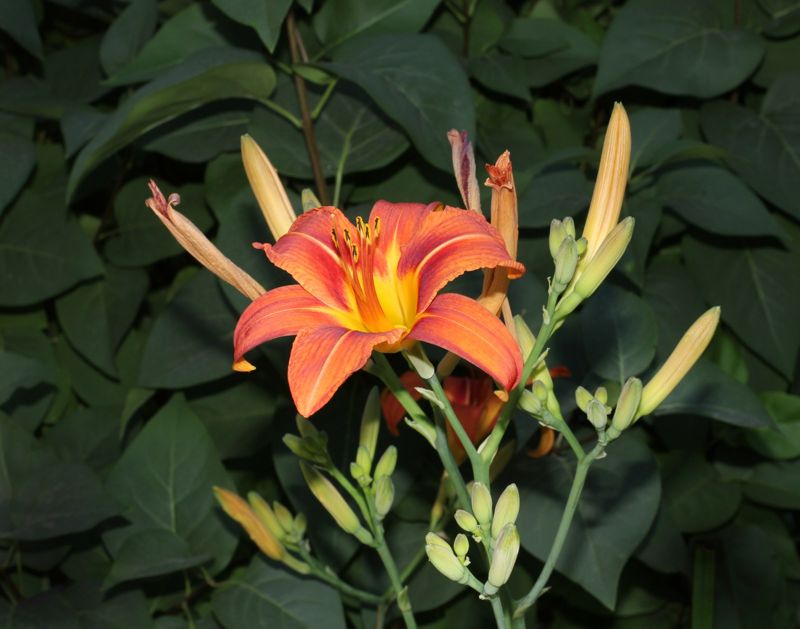
In practice, plant out daylily April to May in moderate zones. Its orange flowers appear from June through August, offering high value to pollinators. It feeds two tables at once: yours and the pollinators’.
Companion Planting & Soil
Daylily grows well alongside hosta, iris, rudbeckia, and ornamental grass.
Good Companions
Planting Calendar
When to sow, transplant, and harvest by growing zone.
| Zone | Action | Months | Notes |
|---|---|---|---|
| Moderate (5-7) | Transplant | Apr — May | Plant in spring or fall; virtually indestructible |
| Moderate (5-7) | Divide | Mar — Apr | Divide every 3-5 years; replant divisions immediately |
Uses
In the Kitchen
In the kitchen, daylily turns up in more than one form: flower buds stir-fried or battered and fried (golden needles); open flowers stuffed with cheese or dip; young spring shoots eaten like asparagus.
Medicinal & Folk Use
In herbal and folk tradition, it has been valued in several ways: root traditionally used in Chinese medicine as a mild sedative; flowers contain compounds studied for antidepressant effects; rich in vitamins A and C. These are traditional uses, not medical advice.
Beyond the Garden
Daylily earns its keep past the plate, too: virtually indestructible ornamental perennial; erosion control on slopes and banks; over 80,000 registered cultivars for collectors.
Safety Notes
Eat a small amount first: even correctly identified daylilies cause nausea or diarrhea in a minority of people. Never confuse daylilies (Hemerocallis — the edible "golden needles" of Chinese cooking) with true lilies (Lilium) or other look-alike bulbs, several of which are dangerously toxic — and true lilies are lethal to cats. Only eat plants you grew or identified with certainty.
The Field Library
Books from the Futurespore shelf that go deeper on plants like this one.
- The Modern Herbal Dispensatory a working reference for tinctures, salves, and doses once you get serious
- Northeast Foraging region-tuned wild food guidance with clear lookalike warnings
- Braiding Sweetgrass reframes growing and gathering as a relationship of reciprocity
These are Bookshop.org affiliate links — they support independent bookstores and earn Futurespore a small commission at no extra cost to you. Browse the full Futurespore Bookshelf.