 User:MarkusHagenlocher / CC BY-SA 3.0
Quinoa
Chenopodium quinoa
Overview
An ancient Andean grain (technically a pseudo-cereal related to spinach and beets) that was so important to the Inca Empire that they called it the 'mother of all grains.' Quinoa is one of the rare plant foods that provides a complete protein with all nine essential amino acids. Its seeds must be rinsed to remove bitter saponins before cooking, and the young leaves are also edible as a nutritious green.
Growing Conditions
How to Grow Quinoa
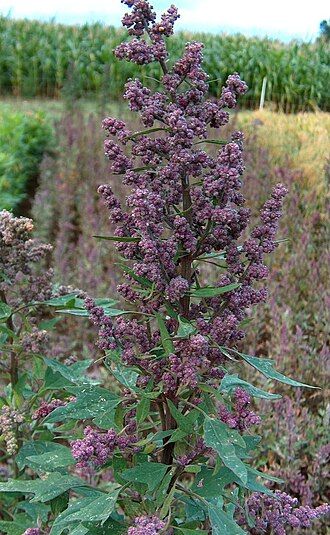
Quinoa (Chenopodium quinoa) is a forb/herb that grows to about 5 feet tall and 12 inches wide.
To grow quinoa, give it full sun. It is hardy across USDA hardiness zones 10–12. Plant it in well-drained, fertile, sandy or loamy soil, at a slightly acidic pH of 6–7.5. It does best with even, moderate watering.
Exact sowing, transplanting, and harvest months shift by climate zone — the planting calendar below lays them out for cool through hot regions. Its flowers appear from July through October. Give it a season to establish, and it carries itself through the dry stretches.
Companion Planting & Soil
Quinoa grows well alongside corn, bean, and sunflower.
Good Companions
Planting Calendar
When to sow, transplant, and harvest by growing zone.
| Zone | Action | Months | Notes |
|---|---|---|---|
| Cold (1-2) | Direct Sow | May — Jun | Direct sow after last frost; prefers cool nights below 95°F days |
| Cold (1-2) | Harvest | Aug — Sep | Harvest when leaves have dropped and seeds resist denting with fingernail |
| Cool (3-4) | Direct Sow | Apr — May | Direct sow in spring; needs 90-120 days; cool nights essential |
| Cool (3-4) | Harvest | Aug — Sep | Harvest when seed heads dry on stalk; rinse saponins before eating |
| Moderate (5-7) | Direct Sow | Apr — May | Direct sow in early spring; heat above 95°F causes sterility |
| Moderate (5-7) | Harvest | Jul — Sep | Cut heads when dry; thresh and winnow; rinse well |
| Warm (8-9) | Direct Sow | Feb — Mar | Sow in late winter; must mature before summer heat |
| Warm (8-9) | Harvest | May — Jul | Harvest before summer peak |
| Hot (10+) | Direct Sow | Nov — Dec | Fall/winter crop only; cannot tolerate sustained heat above 95°F |
| Hot (10+) | Harvest | Mar — Apr | Harvest late winter crop before heat |
Uses
In the Kitchen
In the kitchen, quinoa turns up in more than one form: cooked as a grain base for bowls, salads, and pilafs; ground into flour for gluten-free baking; young leaves cooked as a nutritious green.
Medicinal & Folk Use
In herbal and folk tradition, it has been valued in several ways: complete protein with all essential amino acids; high in iron, magnesium, and B vitamins; naturally gluten-free for celiac-safe diets. These are traditional uses, not medical advice.
Beyond the Garden
Quinoa earns its keep past the plate, too: drought-tolerant grain crop for high altitudes; dramatic ornamental seed heads in red, orange, and gold.
Safety Notes
Rinse quinoa before cooking to wash off its bitter saponin coating — that is the whole of its "toxicity".
The Field Library
Books from the Futurespore shelf that go deeper on plants like this one.
- The Forager's Harvest identification, harvest windows, and preparation from someone who eats what he teaches
- Gaia's Garden home-scale permaculture — guilds, food forests, and beds that tend themselves
These are Bookshop.org affiliate links — they support independent bookstores and earn Futurespore a small commission at no extra cost to you. Browse the full Futurespore Bookshelf.