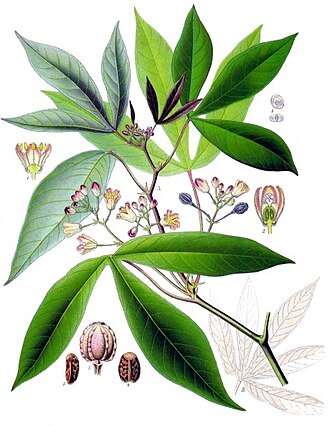
 Franz Eugen Köhler, Köhlers Medizinal-Pflanzen / Public domain
Cassava
Manihot esculenta
Overview
The starchy tuberous root that feeds over 800 million people worldwide, cassava is the third-largest source of calories in the tropics after rice and corn. Also known as yuca, manioc, or tapioca plant, it is remarkably drought-tolerant and productive in poor soils where other crops fail. Raw cassava must always be properly processed to remove naturally occurring cyanogenic compounds.
Cassava (Manihot esculenta) is a remarkable plant that has played a significant role in human history, particularly in tropical and subtropical regions. This woody shrub, belonging to the spurge family (Euphorbiaceae), originated in South America, with native ranges spanning countries like Brazil, Paraguay, and parts of the Andes.
Appearance and Distinguishing Features
Cassava plants grow as annual or perennial shrubs, reaching heights of up to 4 meters (13 feet) under ideal conditions. The leaves are compound, featuring 5-7 leaflets that are oblong in shape and can grow up to 30 centimeters (12 inches) long. The most distinguishing feature is the starchy tuberous root, which can be elongated or rounded, measuring between 20-60 centimeters (8-24 inches) long and weighing from 0.5 to over 2 kilograms (1-5 pounds). The skin of the cassava root varies in color from brown to earthy tones, while the interior flesh ranges from white to a pale yellow.
Native Range and Habitat
Manihot esculenta is native to the lands stretching from southern Brazil across the Guyanas down to Colombia and Venezuela. It thrives in the tropical climate zones with well-distributed rainfall and high humidity levels. The plant adapts well to various soil types but prefers those that are fertile, well-drained, and slightly acidic.
Growing Conditions and Care
Cassava is a hardy plant that can tolerate a wide range of temperatures, from 10°C (50°F) to over 40°C (104°F). It requires a long growing season with at least six months of warm weather for the roots to develop adequately. Cassava grows best in full sun exposure and can be cultivated in areas with altitudes ranging up to 2000 meters (6562 feet) above sea level, provided there is adequate moisture.
The plant thrives in well-prepared soil that has been cleared of weeds and other competing plants. Proper spacing of about one meter (3 feet) between plants ensures better root development. Cassava is a drought-tolerant crop but requires sufficient water during the early stages to establish strong roots.
Uses
Edible: The most valuable part of the cassava plant is its starchy, tuberous root. When cooked and properly prepared, it offers a nutritious source of carbohydrates, being rich in calories but low in protein, fat, vitamins, and minerals. The versatility of cassava roots extends to various culinary preparations, from simple boiling or frying to intricate dishes like the Brazilian "farofa" and the West African staple, "garri."
Medicinal
Cassava leaves have been used for centuries by indigenous people for medicinal purposes. They contain several compounds that exhibit anti-inflammatory, analgesic, and antimicrobial properties.
Ecological
In its natural habitat, cassava provides an important food source for animals such as birds and mammals. It also supports soil conservation and improves biodiversity through its deep root system, which helps prevent erosion.
Cultural or Historical Significance
The cultivation of cassava dates back to pre-Columbian times in South America. It played a crucial role in the survival of indigenous populations before and after European contact due to its high tolerance to droughts and poor soil quality. Cassava was then introduced to Africa, Asia, and Oceania by explorers and traders, becoming a staple food crop in many parts of the world.
Notable Varieties or Related Species
There are thousands of cassava varieties worldwide, with significant differences in root yield, size, shape, and taste. Some notable varieties include:
1. "Agral" (or "Agual") - A high-yielding variety from Brazil that has been widely adopted for its reliability and consistency.
2. "Naseera" - An improved variety developed for the Asian market, known for its resistance to pests and diseases.
3.
Growing Conditions
Habitat & Range
- Habitat
- Shrublands & Hedgerows
- Native Range
- also native to Bolivia, Brazil North, Brazil Northeast and 6 more regions; introduced in 5 US states
- Cultivation Region
- Subtropical to tropical
Botanical data via projectGAIA.
Companion Planting & Soil
Good Companions
Sowing & Propagation
Propagation Methods
Planting Calendar
When to sow, transplant, and harvest by growing zone.
| Zone | Action | Months | Notes |
|---|---|---|---|
| Warm (8-9) | Transplant | Apr — May | Plant stem cuttings 6-8" long at 45° angle; frost-free season of 8+ months required |
| Warm (8-9) | Harvest | Oct — Dec | Harvest roots 8-12 months after planting; peel and cook immediately — raw roots contain cyanide |
| Hot (10+) | Transplant | Mar — May | Plant cuttings in spring; full sun; tolerates poor soil and drought once established |
| Hot (10+) | Harvest | Sep — Dec | Dig roots as needed; sweet varieties can be boiled directly; bitter varieties need processing |
Uses
Culinary
- Boiled, fried, or mashed like potatoes
- Processed into tapioca pearls and flour
- Fermented into garri and fufu in West African cuisine
Medicinal
- Resistant starch supports gut microbiome health
- Starchy root provides sustained energy
- Leaf extract traditionally used for headaches in tropical medicine
Other Uses
- Biofuel feedstock in tropical regions
- Starch used in industrial adhesives and textiles
- Drought-resilient food security crop
Safety Notes
The leaves contain the harmful glucoside linamarin, which can release the toxic hydrocyanic acid in the presence of the enzyme linase[298 , 300 ]. This can be destroyed by heat[298 ] (Parts of plant are poisonous if ingested)