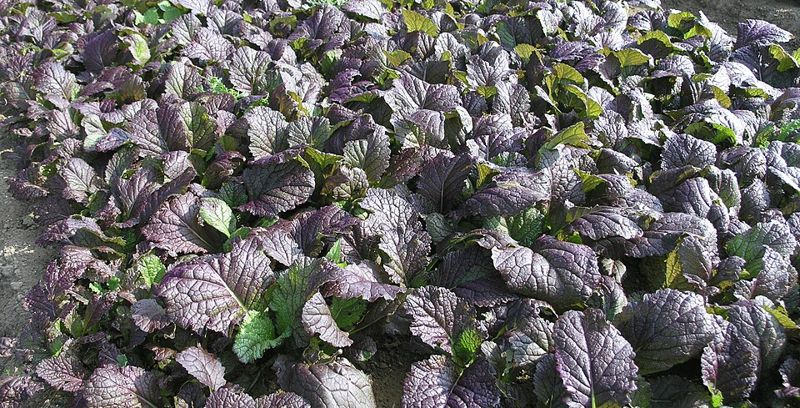
 Goldlocki / CC BY-SA 3.0 · Source
Mizuna
Brassica juncea var. rugosa
Overview
A mild, feathery Japanese mustard green that adds texture and gentle peppery flavor to salads and stir-fries. Mizuna is one of the most productive and resilient salad greens, capable of regrowing multiple times after cutting. It withstands heat better than most salad greens and tolerates light frost, making it a nearly year-round crop in many climates.
Growing Conditions
How to Grow Mizuna
Mizuna (Brassica juncea var. rugosa) is a forb/herb that grows to about 12 inches tall and 12 inches wide.
To grow mizuna, give it partial sun to partial shade. It is hardy across USDA hardiness zones 4–9. Plant it in moist, fertile, well-drained soil, at a slightly acidic pH of 6–7.5. It does best with even, moderate watering.
Exact sowing, transplanting, and harvest months shift by climate zone — the planting calendar below lays them out for cool through hot regions. Give it what it asks for here, and it will find its place in the garden.
Companion Planting & Soil
Mizuna grows well alongside carrot, onion, radish, and lettuce.
Good Companions
Planting Calendar
When to sow, transplant, and harvest by growing zone.
| Zone | Action | Months | Notes |
|---|---|---|---|
| Cold (1-2) | Direct Sow | Apr — May | Direct sow 2-3 weeks before last frost; very cold tolerant; fast growing |
| Cold (1-2) | Direct Sow | Jul — Aug | Late summer sow for fall harvest |
| Cold (1-2) | Harvest | May — Jun | Cut-and-come-again at 4-6" tall; feathery leaves mild and peppery |
| Cold (1-2) | Harvest | Aug — Oct | Fall harvest; tolerates frost |
| Cool (3-4) | Direct Sow | Mar — May | Direct sow early spring; succession sow every 2-3 weeks |
| Cool (3-4) | Direct Sow | Aug — Sep | Fall sowing; overwinters with protection in many areas |
| Cool (3-4) | Harvest | Apr — Jun | Harvest outer leaves or cut whole plant 1" above crown |
| Cool (3-4) | Harvest | Sep — Nov | Fall/early winter harvest |
| Moderate (5-7) | Direct Sow | Feb — Apr | Sow late winter through spring; bolt resistant compared to other Asian greens |
| Moderate (5-7) | Direct Sow | Aug — Oct | Fall sowing for extended harvest |
| Moderate (5-7) | Harvest | Mar — May | Spring harvest; regrows 3-4 times from crown |
| Moderate (5-7) | Harvest | Sep — Dec | Fall through early winter |
| Warm (8-9) | Direct Sow | Sep — Nov | Fall through early winter sowing |
| Warm (8-9) | Harvest | Oct — Mar (wraps) | Harvest through cool season |
| Hot (10+) | Direct Sow | Oct — Dec | Cool-season crop; mild peppery flavor |
| Hot (10+) | Harvest | Nov — Feb (wraps) | Winter harvest; excellent salad green |
Uses
In the Kitchen
In the kitchen, mizuna turns up in more than one form: raw in salads for mild peppery crunch; stir-fried or added to soups at the last minute; mixed into hot pot and ramen.
Medicinal & Folk Use
In herbal and folk tradition, it has been valued in several ways: rich in glucosinolates with cancer-protective properties; high in vitamins A, C, and K; good source of folate and calcium. These are traditional uses, not medical advice.
Beyond the Garden
Mizuna earns its keep past the plate, too: excellent cut-and-come-again salad crop for intensive gardening.
The Field Library
Books from the Futurespore shelf that go deeper on plants like this one.
- Northeast Foraging region-tuned wild food guidance with clear lookalike warnings
- Braiding Sweetgrass reframes growing and gathering as a relationship of reciprocity
These are Bookshop.org affiliate links — they support independent bookstores and earn Futurespore a small commission at no extra cost to you. Browse the full Futurespore Bookshelf.