 Craig Franklin / CC BY-SA 3.0 au
Snapdragon
Antirrhinum
Overview
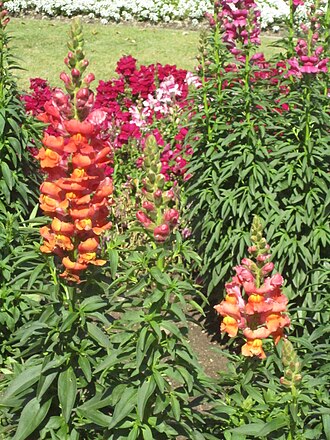
Whimsical flowers whose 'jaws' open and close when squeezed, snapdragons have delighted children and gardeners for centuries. Available in virtually every color except blue, they bloom abundantly in cool weather and are outstanding cut flowers. While technically a short-lived perennial, they are usually grown as annuals and self-seed readily in gardens they enjoy.
Snapdragons, scientifically known as Antirrhinum, belong to the Plantaginaceae family. These plants are commonly referred to as dragon flowers or snapdragons due to their unique flower shape that resembles a dragon's face, which opens and closes its mouth when laterally squeezed. They are also occasionally called toadflax or dog flower.
Native Range and Habitat
Native to rocky areas of Europe, the United States, Canada, and North Africa, Antirrhinum species have been widely used as ornamental plants in borders and as cut flowers.
Growing Conditions
Habitat & Range
- Habitat
- Meadows & Open Areas
- Native Range
- also native to Algeria, France, Italy and 8 more regions; introduced in 19 US states
- Cultivation Region
- Temperate regions
Botanical data via projectGAIA.
Companion Planting & Soil
Good Companions
Sowing & Propagation
Propagation Methods
Planting Calendar
When to sow, transplant, and harvest by growing zone.
| Zone | Action | Months | Notes |
|---|---|---|---|
| Cold (1-2) | Start Indoors | Feb — Mar | Start indoors 8-10 weeks before last frost; needs light to germinate |
| Cold (1-2) | Transplant | May — Jun | Transplant after last frost; pinch tips for bushier plants |
| Cold (1-2) | Harvest | Jun — Aug | Cut when lower third of florets are open; long-lasting cut flower |
| Cool (3-4) | Start Indoors | Jan — Feb | Start indoors 10 weeks before transplant |
| Cool (3-4) | Transplant | Apr — May | Transplant in spring; thrives in cool weather |
| Cool (3-4) | Harvest | May — Jul | Harvest when bottom flowers open; deadhead for rebloom |
| Moderate (5-7) | Transplant | Mar — Apr | Transplant in early spring; blooms spring through early summer |
| Moderate (5-7) | Harvest | Apr — Jun | Cut stems for bouquets; blooms until heat stops them |
| Warm (8-9) | Direct Sow | Sep — Oct | Direct sow in fall for winter/spring bloom |
| Warm (8-9) | Harvest | Nov — Apr (wraps) | Blooms through winter and spring |
| Hot (10+) | Direct Sow | Oct — Nov | Sow in fall; grows through winter; fades in summer heat |
| Hot (10+) | Harvest | Dec — Mar (wraps) | Cool-season blooms |
Uses
Culinary
- Flowers are edible with a mild, slightly bitter flavor
- Decorative garnish for salads and desserts
Medicinal
- Traditional folk remedy as a poultice for skin inflammation
- Historically used in European herbalism for liver complaints
Other Uses
- Outstanding cut flower with long vase life
- Cool-season annual for continuous color
- Attracts bumblebees — only heavy bees can open the flowers