Overview
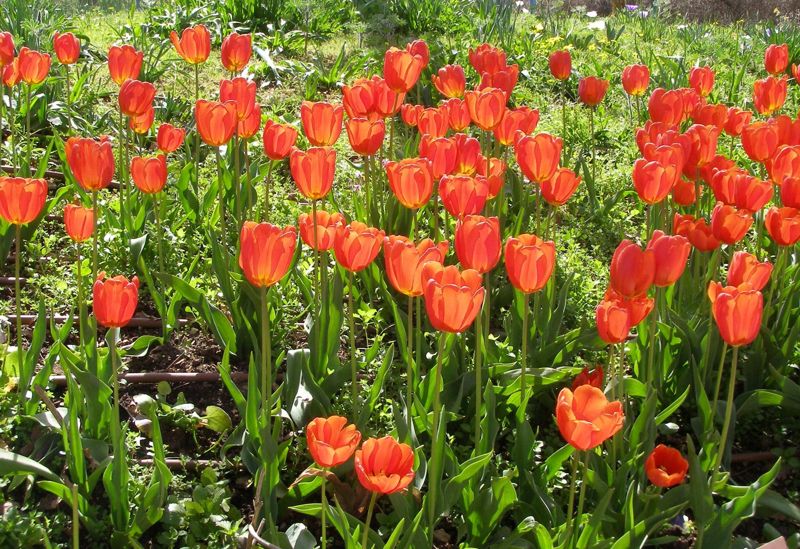
The flower that caused one of history's most famous economic bubbles — Dutch Tulip Mania in 1637 — tulips remain among the world's most popular spring bulbs. Over 3,000 registered varieties offer every color except true blue, with single, double, fringed, parrot, and lily-flowered forms. Tulip petals are edible with a mild, slightly sweet flavor and can substitute for onion in some dishes.
Growing Conditions
How to Grow Tulip
Tulip (Tulipa spp.) is a forb/herb that grows to about 8 inches tall and 1 foot wide.
To grow tulip, give it full sun. It is hardy across USDA hardiness zones 5–9. Plant it in well-drained, fertile, sandy loam, at a slightly acidic pH of 6–7. It does best with even, moderate watering.
Exact sowing, transplanting, and harvest months shift by climate zone — the planting calendar below lays them out for cool through hot regions. Its flowers appear from March through May, offering moderate value to pollinators. Handle it with the respect a defended plant has earned — read the safety notes first.
Companion Planting & Soil
Tulip grows well alongside daffodil, grape hyacinth, forget-me-not, and pansy.
Good Companions
Planting Calendar
When to sow, transplant, and harvest by growing zone.
| Zone | Action | Months | Notes |
|---|---|---|---|
| Cold (1-2) | Transplant | Sep — Oct | Plant bulbs in fall 6-8" deep; needs 12-16 weeks of cold below 45°F |
| Cold (1-2) | Bloom | May — Jun | Spring bloom; let foliage yellow naturally before removing — feeds bulb for next year |
| Cool (3-4) | Transplant | Sep — Oct | Plant bulbs in fall; pointy end up; group 7-15 for visual impact |
| Cool (3-4) | Bloom | Apr — May | Mid-spring bloom; species tulips (botanical) perennialize better than hybrids |
| Moderate (5-7) | Transplant | Oct — Nov | Plant in late fall; wait until soil cools below 60°F |
| Moderate (5-7) | Bloom | Mar — May | Spring bloom; deadhead but leave foliage until yellow |
| Warm (8-9) | Transplant | Nov — Dec | Plant pre-chilled bulbs (refrigerate 8-12 weeks); treat as annual in warm zones |
| Warm (8-9) | Bloom | Feb — Mar | Late winter/early spring bloom; hybrid tulips rarely rebloom in warm zones |
| Hot (10+) | Transplant | Dec — Jan (wraps) | Pre-chill bulbs 12+ weeks; grow as annual; blooms are brief in hot zones |
| Hot (10+) | Bloom | Jan — Feb | Brief winter bloom from pre-chilled bulbs |
Uses
In the Kitchen
In the kitchen: petals as a mild, faintly sweet garnish or edible cup for an appetiser.
Beyond the Garden
Tulip earns its keep past the plate, too: iconic spring garden bulb with thousands of cultivars; premier cut flower for arrangements; naturalizing in cool-climate gardens.
Safety Notes
Petals only, and sparingly. Tulip bulbs are toxic — they contain tuliposides and cause severe gastrointestinal irritation — and the people who ate them during the Dutch famine of 1944-45 were starving, not cooking. Never eat the bulb. Handling bulbs can also cause contact dermatitis.
The Field Library
Books from the Futurespore shelf that go deeper on plants like this one.
- Northeast Foraging region-tuned wild food guidance with clear lookalike warnings
- Braiding Sweetgrass reframes growing and gathering as a relationship of reciprocity
These are Bookshop.org affiliate links — they support independent bookstores and earn Futurespore a small commission at no extra cost to you. Browse the full Futurespore Bookshelf.