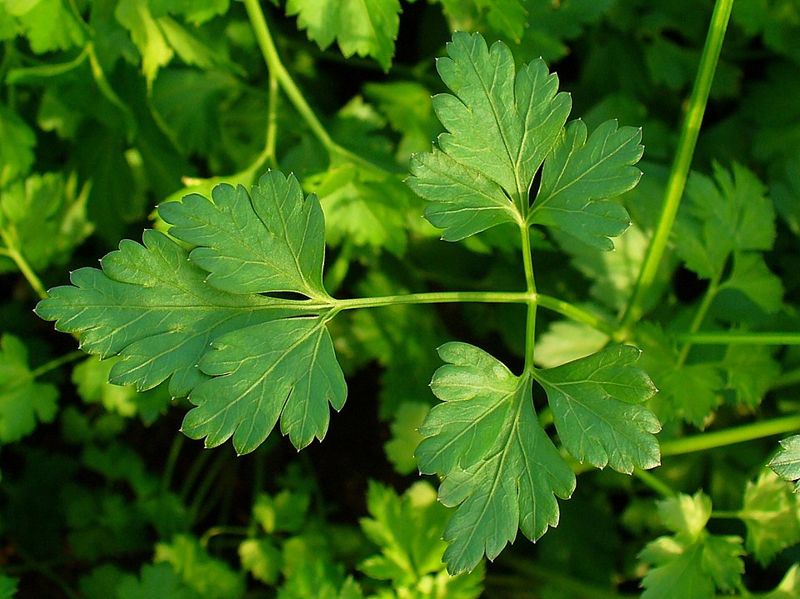
 H. Zell / CC BY-SA 3.0 · Source
Parsley
Petroselinum crispum
Overview
Far more than a plate garnish, parsley is one of the most nutritionally dense herbs available and a foundation of Mediterranean, Middle Eastern, and French cuisine. Flat-leaf (Italian) parsley has the best flavor for cooking, while curly parsley is the classic garnish. It is the main ingredient in tabbouleh and chimichurri, and a host plant for swallowtail butterfly caterpillars.
Mentioned in The Mycelial Grimoire
Posts on the Grimoire that reference Parsley.
Growing Conditions
How to Grow Parsley
Parsley (Petroselinum crispum) is a biennial forb/herb that grows to about 12 inches tall and 12 inches wide.
To grow parsley, give it full sun, though it tolerates a little shade. It is hardy across USDA hardiness zones 3–9. Plant it in rich, moist, well-drained soil, at a slightly acidic pH of 6–7. It does best with even, moderate watering.
Exact sowing, transplanting, and harvest months shift by climate zone — the planting calendar below lays them out for cool through hot regions. Its flowers appear from June through August, offering high value to pollinators. It feeds two tables at once: yours and the pollinators’.
Companion Planting & Soil
Parsley grows well alongside tomato, asparagus, corn, rose, and carrot — but keep it clear of lettuce and mint.
Good Companions
Avoid Planting Near
Planting Calendar
When to sow, transplant, and harvest by growing zone.
| Zone | Action | Months | Notes |
|---|---|---|---|
| Cold (1-2) | Start Indoors | Mar — Apr | Start 8-10 weeks before last frost; slow germination |
| Cold (1-2) | Transplant | Jun — Jun | Transplant after last frost |
| Cold (1-2) | Harvest | Jul — Sep | Cut outer stems; plant produces until hard frost |
| Cool (3-4) | Start Indoors | Feb — Mar | Start 8-10 weeks before last frost |
| Cool (3-4) | Transplant | May — May | Transplant after last frost |
| Cool (3-4) | Harvest | Jun — Oct | Cut outer stems continuously |
| Moderate (5-7) | Start Indoors | Jan — Feb | Start 8-10 weeks before last frost |
| Moderate (5-7) | Transplant | Apr — Apr | Transplant after last frost |
| Moderate (5-7) | Harvest | May — Nov | Cut outer stems continuously |
| Warm (8-9) | Direct Sow | Feb — Mar | Direct sow in early spring |
| Warm (8-9) | Direct Sow | Sep — Oct | Fall sowing for winter harvest |
| Warm (8-9) | Harvest | Mar — Jun | Harvest before bolting in summer heat |
| Hot (10+) | Direct Sow | Oct — Dec | Grow as cool-season crop |
| Hot (10+) | Harvest | Nov — Apr (wraps) | Winter through spring harvest |
Uses
In the Kitchen
In the kitchen, parsley turns up in more than one form: essential in tabbouleh, chimichurri, and gremolata; fresh chopped as finishing herb on virtually any savory dish; stems add depth to stocks and bouquet garni.
Medicinal & Folk Use
In herbal and folk tradition, it has been valued in several ways: exceptionally rich in vitamin K, vitamin C, and iron; traditional diuretic and kidney tonic; chlorophyll-rich natural breath freshener. These are traditional uses, not medical advice.
Beyond the Garden
Parsley earns its keep past the plate, too: host plant for black swallowtail butterfly caterpillars; attracts beneficial insects including tachinid flies.
Safety Notes
Safe in normal culinary amounts. Very large quantities (medicinal doses) should be avoided during pregnancy. Rich in vitamins A, C, K.
The Field Library
Books from the Futurespore shelf that go deeper on plants like this one.
- The Modern Herbal Dispensatory a working reference for tinctures, salves, and doses once you get serious
- Edible Wild Plants a photographic guide organized by season — good for checking an ID twice in the field
- The Resilient Gardener growing staple food through drought, flood, and hard seasons
These are Bookshop.org affiliate links — they support independent bookstores and earn Futurespore a small commission at no extra cost to you. Browse the full Futurespore Bookshelf.