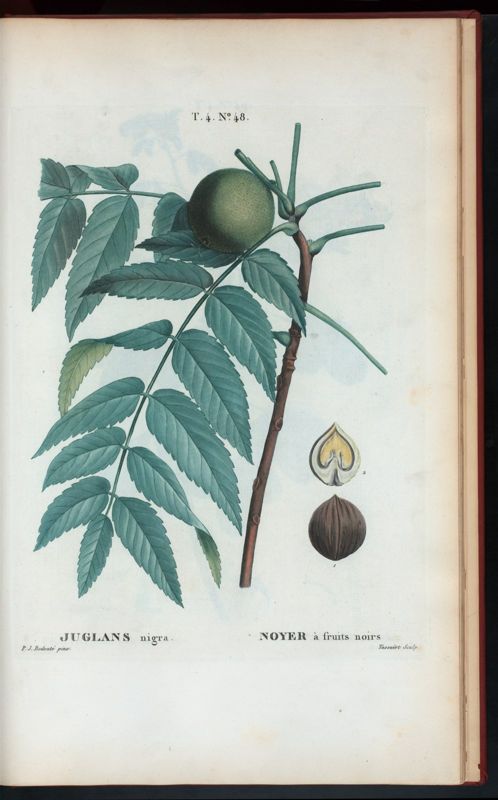
 Scan by NYPL / Public domain · Source
Walnut
Juglans nigra
Overview
A majestic, long-lived tree that produces one of the most nutritionally valuable nuts in the world. Walnuts are uniquely rich in ALA omega-3 fatty acids — the only tree nut with significant omega-3 content. The tree exudes juglone from its roots, a chemical that inhibits the growth of many other plants, so careful planning is needed when integrating walnuts into a food forest.
Growing Conditions
How to Grow Walnut
Walnut (Juglans nigra) is a tree that grows to about 66 feet tall and 59 feet wide.
To grow walnut, give it full sun. It is hardy across USDA hardiness zones 6–10. Plant it in deep, well-drained, fertile, loamy soil, at a slightly acidic pH of 6–7.5. It does best with even, moderate watering.
Exact sowing, transplanting, and harvest months shift by climate zone — the planting calendar below lays them out for cool through hot regions. Its flowers appear from May through May. Match it to the right spot, and the rest is mostly patience.
Companion Planting & Soil
Walnut grows well alongside mulberry, black locust, pawpaw, and currant (some tolerance) — but keep it clear of tomato, pepper, eggplant, apple, blueberry, and most garden crops.
Good Companions
Avoid Planting Near
Planting Calendar
When to sow, transplant, and harvest by growing zone.
| Zone | Action | Months | Notes |
|---|---|---|---|
| Cold (1-2) | Transplant | Apr — May | Plant bare-root in spring; Carpathian walnut hardy to zone 4; needs 50+ foot spacing |
| Cold (1-2) | Harvest | Sep — Oct | Harvest when green hulls split and nuts fall; remove hulls and cure 2-4 weeks |
| Cold (1-2) | Prune | Aug — Sep | Prune in late summer to avoid bleeding; minimal pruning needed once established |
| Cool (3-4) | Transplant | Mar — Apr | Plant bare-root in spring while dormant; deep taproot — choose site permanently |
| Cool (3-4) | Harvest | Sep — Oct | Gather fallen nuts promptly; remove husks and dry |
| Cool (3-4) | Prune | Jul — Aug | Summer prune; avoid winter/spring — sap bleeds heavily |
| Moderate (5-7) | Transplant | Nov — Dec | Plant in late fall; English walnut (zone 5+) or black walnut (zone 4+) |
| Moderate (5-7) | Transplant | Feb — Mar | Spring planting alternative; first nuts in 5-7 years |
| Moderate (5-7) | Harvest | Sep — Nov | Harvest when hulls crack; cure in shade with good ventilation |
| Moderate (5-7) | Prune | Jul — Aug | Prune in summer only; remove dead and crossing branches |
| Warm (8-9) | Transplant | Nov — Dec | Plant during dormancy; needs 400-1500 chill hours by variety |
| Warm (8-9) | Harvest | Sep — Oct | Harvest when hulls split |
| Warm (8-9) | Prune | Jul — Aug | Summer prune; juglone from roots inhibits nearby plants |
| Hot (10+) | Transplant | Dec — Jan (wraps) | Plant in winter; choose low-chill varieties |
| Hot (10+) | Harvest | Aug — Oct | Harvest in late summer/early fall |
Uses
In the Kitchen
In the kitchen, walnut turns up in more than one form: eaten raw or toasted in baking, salads, and pestos; cold-pressed walnut oil for finishing dishes; green walnuts pickled or made into nocino liqueur.
Medicinal & Folk Use
In herbal and folk tradition, it has been valued in several ways: richest tree nut source of ALA omega-3 fatty acids; polyphenols support brain health and cognitive function; anti-inflammatory properties studied for cardiovascular benefits. These are traditional uses, not medical advice.
Beyond the Garden
Walnut earns its keep past the plate, too: prized hardwood for fine furniture and woodworking; hull used as a natural brown-black dye; juglone-aware planting design required.
The Field Library
Books from the Futurespore shelf that go deeper on plants like this one.
- The Forager's Harvest identification, harvest windows, and preparation from someone who eats what he teaches
- Gaia's Garden home-scale permaculture — guilds, food forests, and beds that tend themselves
These are Bookshop.org affiliate links — they support independent bookstores and earn Futurespore a small commission at no extra cost to you. Browse the full Futurespore Bookshelf.