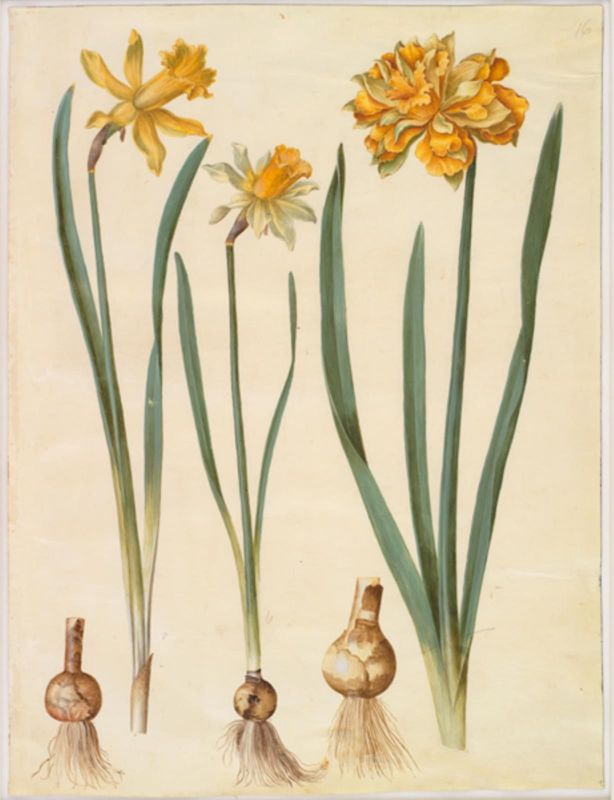
 Hans Simon Holtzbecker / Public domain · Source
Daffodil
Narcissus pseudonarcissus
Overview
Cheerful trumpets of yellow, white, and orange that announce spring's arrival, daffodils are among the most reliable and long-lived spring bulbs. All parts of the plant are toxic, which makes them completely deer-proof — one of very few guaranteed deer-resistant garden plants. They naturalize beautifully and can persist for decades, even centuries, in old homestead gardens.
Growing Conditions
How to Grow Daffodil
Daffodil (Narcissus pseudonarcissus) is a forb/herb that grows to about 1.5 feet tall and 4 inches wide.
To grow daffodil, give it partial sun to partial shade. It is hardy across USDA hardiness zones 4–8. Plant it in well-drained, moderately fertile soil, at a slightly acidic pH of 6–7. It does best with even, moderate watering.
Exact sowing, transplanting, and harvest months shift by climate zone — the planting calendar below lays them out for cool through hot regions. Its yellow flowers appear from March through May, offering high value to pollinators. A plant worth learning slowly, the way it has been used for generations.
Companion Planting & Soil
Daffodil grows well alongside hosta, daylily, and fern.
Good Companions
Planting Calendar
When to sow, transplant, and harvest by growing zone.
| Zone | Action | Months | Notes |
|---|---|---|---|
| Cold (1-2) | Transplant | Sep — Oct | Plant bulbs in fall 6" deep; deer and rodent proof; perennial to zone 3 |
| Cold (1-2) | Bloom | Apr — May | Early to mid-spring bloom; toxic to deer and rodents |
| Cool (3-4) | Transplant | Sep — Oct | Plant in fall; naturalizes and multiplies over decades |
| Cool (3-4) | Bloom | Mar — May | Spring bloom; leave foliage 6 weeks after flowering |
| Moderate (5-7) | Transplant | Oct — Nov | Plant in fall when soil cools; excellent for naturalizing in lawns |
| Moderate (5-7) | Bloom | Feb — Apr | Late winter/spring bloom; all parts toxic if ingested |
| Moderate (5-7) | Divide | Jun — Jul | Divide crowded clumps after foliage dies back; replant immediately |
| Warm (8-9) | Transplant | Nov — Dec | Plant in late fall; choose heat-tolerant jonquils and tazetta types |
| Warm (8-9) | Bloom | Jan — Mar | Late winter bloom; paperwhites bloom without chilling |
| Hot (10+) | Transplant | Dec — Jan (wraps) | Pre-chill large-cupped types 6-8 weeks; tazetta types need no chill |
| Hot (10+) | Bloom | Dec — Feb (wraps) | Winter bloom; paperwhites and tazetta types most reliable |
Uses
Medicinal & Folk Use
In herbal and folk tradition: galantamine derived from daffodils is used in Alzheimer's treatment. These are traditional uses, not medical advice.
Beyond the Garden
Daffodil earns its keep past the plate, too: completely deer-proof and rodent-proof spring bulb; naturalizing for decades in meadows and woodlands; cut flowers with excellent vase life.
Safety Notes
Every part of a daffodil is poisonous, the bulb most of all. Daffodil bulbs are mistaken for onions, and the leaves for chives or garlic greens, often enough that poison centers see it every spring — store flower bulbs well away from the kitchen. The sap causes "daffodil itch" in florists.
The Field Library
Books from the Futurespore shelf that go deeper on plants like this one.
- Medicinal Herbs: A Beginner's Guide the friendliest on-ramp to growing and using healing herbs at home
- Gaia's Garden home-scale permaculture — guilds, food forests, and beds that tend themselves
These are Bookshop.org affiliate links — they support independent bookstores and earn Futurespore a small commission at no extra cost to you. Browse the full Futurespore Bookshelf.