Spiderwort
Tradescantia spp.
Overview
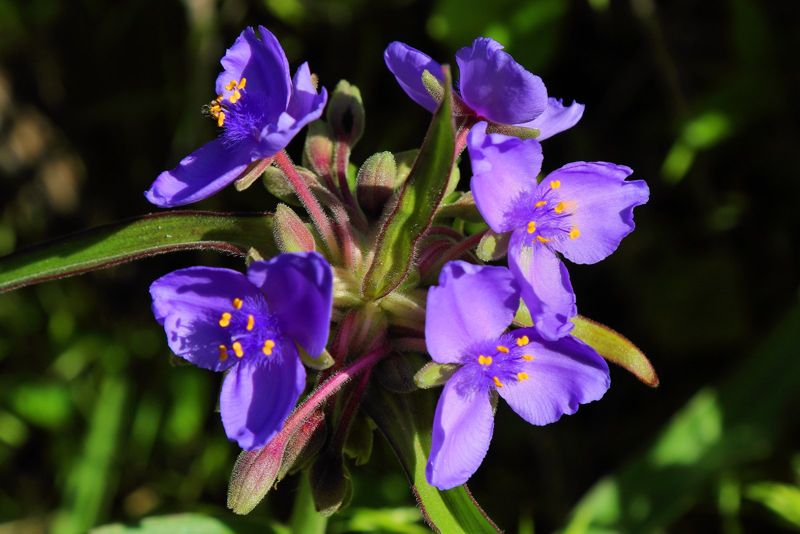
A native perennial whose three-petaled flowers in vivid blue, purple, and pink open fresh each morning and dissolve by afternoon, creating a constantly renewing display. Spiderwort is remarkably useful as a biological indicator — its stamens change color in response to radiation and chemical pollution. All parts are edible and were used as food and medicine by numerous Native American peoples.
Growing Conditions
How to Grow Spiderwort
Spiderwort (Tradescantia spp.) is a forb/herb that grows to about 1.5 feet tall and 12 inches wide.
To grow spiderwort, give it partial sun to partial shade. It is hardy across USDA hardiness zones 7–11. Plant it in moist, fertile, well-drained soil; adaptable to most conditions, at a slightly acidic pH of 5.5–7.5. It does best with even, moderate watering.
Exact sowing, transplanting, and harvest months shift by climate zone — the planting calendar below lays them out for cool through hot regions. Its flowers appear from March through December, offering moderate value to pollinators. Come to it with patience — its value is the kind that rewards knowing.
Companion Planting & Soil
Spiderwort grows well alongside daylily, hosta, fern, and iris.
Good Companions
Planting Calendar
When to sow, transplant, and harvest by growing zone.
| Zone | Action | Months | Notes |
|---|---|---|---|
| Cold (1-2) | Transplant | May — Jun | Plant in spring; native perennial; three-petaled blue-purple flowers |
| Cold (1-2) | Bloom | May — Jul | Blue-purple flowers open mornings; each flower lasts one day |
| Cool (3-4) | Transplant | Apr — May | Plant in spring; adaptable to sun or shade; flowers open in morning |
| Cool (3-4) | Bloom | May — Jul | Spring/summer bloom; flowers close by afternoon; indicator of radiation exposure |
| Moderate (5-7) | Transplant | Mar — Apr | Plant in spring; cut back hard after first bloom for rebloom in fall |
| Moderate (5-7) | Bloom | Apr — Jul | Long bloom spring through summer; shear back for fall rebloom |
| Moderate (5-7) | Divide | Mar — Apr | Divide every 3-4 years in spring; easy to propagate |
| Warm (8-9) | Transplant | Feb — Mar | Plant in late winter; shade tolerant |
| Warm (8-9) | Bloom | Mar — Jun | Spring bloom; goes dormant in summer heat |
| Hot (10+) | Transplant | Nov — Dec | Plant in fall; needs afternoon shade in hot zones |
| Hot (10+) | Bloom | Feb — May | Late winter/spring bloom; dormant in summer |
Uses
In the Kitchen
In the kitchen, spiderwort turns up in more than one form: young leaves and stems cooked as a pot green; flowers as edible garnish; mucilaginous sap used to thicken soups (traditionally).
Medicinal & Folk Use
In herbal and folk tradition, it has been valued in several ways: poultice from crushed leaves for insect bites and stings; traditional laxative and stomach remedy. These are traditional uses, not medical advice.
Beyond the Garden
Spiderwort earns its keep past the plate, too: biological pollution indicator (stamen hair cells change color); low-maintenance native perennial for naturalized plantings.
Safety Notes
Applies to native North American spiderworts (Tradescantia ohiensis, T. virginiana) only. The trailing houseplant tradescantias (inch plant, T. zebrina) are a different branch of the genus whose sap irritates skin and sickens pets — do not eat those, and wash after handling them.
The Field Library
Books from the Futurespore shelf that go deeper on plants like this one.
- Medicinal Herbs: A Beginner's Guide the friendliest on-ramp to growing and using healing herbs at home
- Edible Wild Plants a photographic guide organized by season — good for checking an ID twice in the field
- The Resilient Gardener growing staple food through drought, flood, and hard seasons
These are Bookshop.org affiliate links — they support independent bookstores and earn Futurespore a small commission at no extra cost to you. Browse the full Futurespore Bookshelf.