 Wikimedia Commons / Public domain · Source
Fava bean
Vicia faba
Overview
One of the oldest cultivated food plants, fava beans have nourished Mediterranean and Middle Eastern civilizations since the Bronze Age. These large, buttery legumes grow in cool weather when most other beans cannot, making them a valuable spring and fall crop. Their deep taproots fix nitrogen and break up compacted soil, providing dual service as food and soil-builder.
Growing Conditions
How to Grow Fava bean
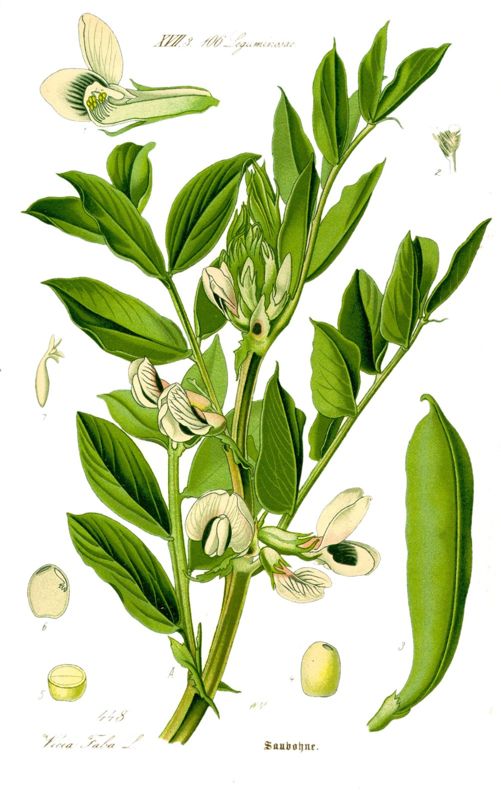
Fava bean (Vicia faba) is an annual forb/herb that grows to about 3 feet tall and 2.5 feet wide.
To grow fava bean, give it partial sun to partial shade. It is hardy across USDA hardiness zones 5–9. Plant it in well-drained, fertile, clay or loam soil, at a slightly acidic pH of 6–7. It does best with even, moderate watering.
Exact sowing, transplanting, and harvest months shift by climate zone — the planting calendar below lays them out for cool through hot regions. Its flowers appear from May through July, offering high value to pollinators. Water it in well, then largely leave it be — it forgives a dry week.
Companion Planting & Soil
Fava bean grows well alongside potato, corn, cabbage, and lettuce — but keep it clear of onion, garlic, and fennel.
Good Companions
Avoid Planting Near
Planting Calendar
When to sow, transplant, and harvest by growing zone.
| Zone | Action | Months | Notes |
|---|---|---|---|
| Cold (1-2) | Direct Sow | May — May | Direct sow as soon as soil is workable; tolerates light frost |
| Cold (1-2) | Harvest | Jul — Aug | Harvest when pods are plump; beans should be bright green |
| Cool (3-4) | Direct Sow | Mar — Apr | Sow early spring; cool-season crop that needs 80-100 days |
| Cool (3-4) | Harvest | Jun — Jul | Harvest when pods feel full; double-peel for best flavor |
| Moderate (5-7) | Direct Sow | Feb — Mar | Sow in late winter/early spring; prefers temps 60-65°F |
| Moderate (5-7) | Direct Sow | Oct — Nov | Fall sow for overwintering in mild areas |
| Moderate (5-7) | Harvest | May — Jun | Harvest spring-sown crop |
| Warm (8-9) | Direct Sow | Oct — Dec | Sow in fall/early winter; grows through cool months |
| Warm (8-9) | Harvest | Feb — Apr | Harvest late winter/early spring |
| Hot (10+) | Direct Sow | Nov — Jan (wraps) | Sow in late fall/winter; cannot tolerate heat |
| Hot (10+) | Harvest | Feb — Mar | Harvest before heat arrives |
Uses
In the Kitchen
In the kitchen, fava bean turns up in more than one form: fresh or dried in Mediterranean and Middle Eastern dishes; young pods eaten whole like snap beans; pureed into dips, falafel, and ful medames.
Medicinal & Folk Use
In herbal and folk tradition, it has been valued in several ways: rich in L-dopa, studied for Parkinson's disease support; high in plant protein, folate, and fiber; iron-rich for supporting blood health. These are traditional uses, not medical advice.
Beyond the Garden
Fava bean earns its keep past the plate, too: cool-season nitrogen fixer for crop rotations; cover crop that improves soil structure.
Safety Notes
Fava beans cause favism, an acute haemolytic anaemia, in people with G6PD deficiency — one of the most common human enzyme deficiencies, concentrated in people of Mediterranean, Middle Eastern and African descent. For everyone else they are an ordinary, excellent food. If fava beans have ever made you or a relative suddenly and severely ill, ask about G6PD before eating them again. Cook them; raw beans are higher in the compounds responsible (vicine and convicine).
The Field Library
Books from the Futurespore shelf that go deeper on plants like this one.
- The Forager's Harvest identification, harvest windows, and preparation from someone who eats what he teaches
- Gaia's Garden home-scale permaculture — guilds, food forests, and beds that tend themselves
These are Bookshop.org affiliate links — they support independent bookstores and earn Futurespore a small commission at no extra cost to you. Browse the full Futurespore Bookshelf.