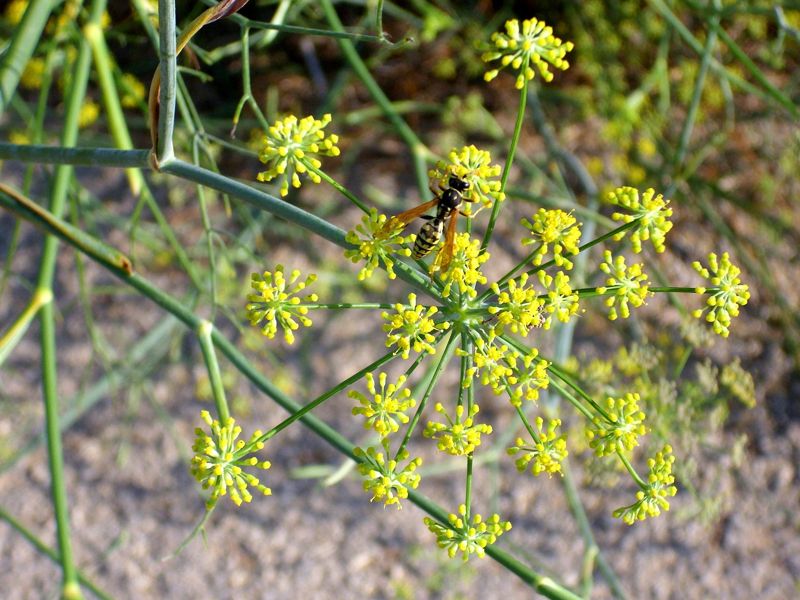
 Javier martin / Public domain · Source
Fennel
Foeniculum vulgare
Overview
A graceful, anise-scented plant that offers three harvests in one — the crunchy bulb, the feathery fronds, and the aromatic seeds. Florence fennel is grown for its swollen bulb base, while herb fennel is grown for foliage and seeds. Fennel is famously allelopathic, inhibiting the growth of nearby plants, so it's best grown in its own dedicated space.
Mentioned in The Mycelial Grimoire
Posts on the Grimoire that reference Fennel.
Growing Conditions
How to Grow Fennel
Fennel (Foeniculum vulgare) is a forb/herb that grows to about 5 feet tall and 3 feet wide.
To grow fennel, give it full sun. It is hardy across USDA hardiness zones 5–9. Plant it in rich, well-drained, sandy or loamy soil, at a slightly acidic pH of 5.5–7. It does best with even, moderate watering.
Exact sowing, transplanting, and harvest months shift by climate zone — the planting calendar below lays them out for cool through hot regions. Its flowers appear from June through August, offering high value to pollinators. It is a plant for the low-water garden — patient through heat, slow to complain.
Companion Planting & Soil
Fennel grows well alongside dill and sage — but keep it clear of tomato, bean, pepper, carrot, kohlrabi, and most vegetables.
Good Companions
Avoid Planting Near
Planting Calendar
When to sow, transplant, and harvest by growing zone.
| Zone | Action | Months | Notes |
|---|---|---|---|
| Cold (1-2) | Start Indoors | Mar — Apr | Start indoors 4 weeks before last frost; dislikes transplanting — use peat pots |
| Cold (1-2) | Transplant | May — Jun | Transplant carefully; taproot is sensitive |
| Cold (1-2) | Harvest | Jul — Sep | Harvest fronds anytime; bulb when 3" across; seeds when brown |
| Cool (3-4) | Direct Sow | Apr — May | Direct sow in spring; thin to 12" apart |
| Cool (3-4) | Harvest | Jun — Sep | Cut fronds as needed; harvest bulb at 3" |
| Moderate (5-7) | Direct Sow | Mar — Apr | Sow in early spring; keep away from dill (cross-pollinates) |
| Moderate (5-7) | Direct Sow | Aug — Sep | Fall sowing for bulb fennel |
| Moderate (5-7) | Harvest | May — Jul | Spring harvest; cut bulb at soil line |
| Moderate (5-7) | Harvest | Nov — Dec | Fall bulb harvest |
| Warm (8-9) | Direct Sow | Sep — Oct | Fall sowing; bolts in spring heat |
| Warm (8-9) | Harvest | Dec — Mar (wraps) | Harvest during cool months |
| Hot (10+) | Direct Sow | Oct — Dec | Cool-season crop; sow in fall |
| Hot (10+) | Harvest | Jan — Mar | Winter/early spring harvest |
Uses
In the Kitchen
In the kitchen, fennel turns up in more than one form: bulb sliced raw in salads or braised and roasted; fronds as a delicate garnish for fish and salads; seeds used in sausage, bread, and spice blends.
Medicinal & Folk Use
In herbal and folk tradition, it has been valued in several ways: carminative seed tea for gas, bloating, and colic; estrogenic compounds traditionally used for milk production; anti-inflammatory and antispasmodic for digestive comfort. These are traditional uses, not medical advice.
Beyond the Garden
Fennel earns its keep past the plate, too: host plant for swallowtail butterfly caterpillars; bronze fennel is a stunning ornamental with copper foliage.
Safety Notes
Garden fennel is safe as food. Never forage wild fennel-like plants unless you are expert: poison hemlock has similar feathery foliage, grows in the same waste ground, and is fatal to eat. Concentrated fennel oil is not for internal use; the sap causes photosensitivity in some people.
The Field Library
Books from the Futurespore shelf that go deeper on plants like this one.
- The Modern Herbal Dispensatory a working reference for tinctures, salves, and doses once you get serious
- The Forager's Harvest identification, harvest windows, and preparation from someone who eats what he teaches
- Gaia's Garden home-scale permaculture — guilds, food forests, and beds that tend themselves
These are Bookshop.org affiliate links — they support independent bookstores and earn Futurespore a small commission at no extra cost to you. Browse the full Futurespore Bookshelf.