Rosemary
Rosmarinus officinalis
Overview
A fragrant, evergreen Mediterranean shrub that has symbolized remembrance since ancient Greece, where students wore rosemary garlands during exams to improve memory. Modern research has validated its cognitive-enhancing properties — simply smelling rosemary can improve alertness and memory. Its resinous, pine-like flavor is essential in Mediterranean cooking, and it grows into a beautiful, drought-tolerant landscape shrub.
Mentioned in The Mycelial Grimoire
Posts on the Grimoire that reference Rosemary.
Growing Conditions
How to Grow Rosemary
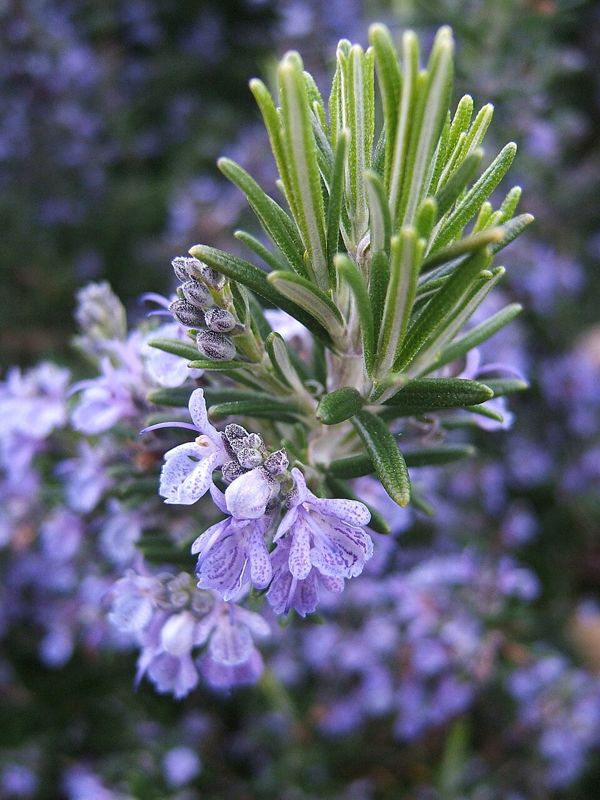
Rosemary (Rosmarinus officinalis) is a shrub that grows to about 5 feet tall and 5 feet wide.
To grow rosemary, give it full sun. It is hardy across USDA hardiness zones 7a–9. Plant it in well-drained, lean, sandy or rocky soil; drought-tolerant, at a near-neutral pH of 6–8. It does best with dry, sharply drained conditions.
Exact sowing, transplanting, and harvest months shift by climate zone — the planting calendar below lays them out for cool through hot regions. Its blue flowers appear from April through May, offering high value to pollinators. It is a plant for the low-water garden — patient through heat, slow to complain.
Companion Planting & Soil
Rosemary grows well alongside sage, thyme, lavender, bean, cabbage, and carrot.
Good Companions
Planting Calendar
When to sow, transplant, and harvest by growing zone.
| Zone | Action | Months | Notes |
|---|---|---|---|
| Cold (1-2) | Start Indoors | Feb — Mar | Start indoors 10-12 weeks early; slow to germinate (2-3 weeks); grow as annual or overwinter in pot |
| Cold (1-2) | Transplant | Jun — Jun | Transplant after last frost; bring indoors before first fall frost |
| Cold (1-2) | Harvest | Jun — Sep | Harvest sprigs as needed; dry or freeze for winter use |
| Cool (3-4) | Start Indoors | Jan — Feb | Start indoors; or buy transplants — seed germination unreliable |
| Cool (3-4) | Transplant | May — Jun | Transplant after frost; borderline hardy — mulch heavily or pot up in fall |
| Cool (3-4) | Harvest | May — Oct | Cut sprigs anytime plant is actively growing |
| Moderate (5-7) | Transplant | Apr — May | Plant in spring; excellent drainage essential — raised beds or gravel mulch |
| Moderate (5-7) | Harvest | Mar — Nov | Harvest year-round in mild winters |
| Moderate (5-7) | Prune | Mar — Apr | Shape after spring bloom; never cut into old wood — it will not regrow |
| Warm (8-9) | Transplant | Mar — Apr | Plant in spring; evergreen perennial; thrives in heat with little water |
| Warm (8-9) | Harvest | Jan — Dec | Harvest year-round; evergreen perennial |
| Warm (8-9) | Prune | Feb — Mar | Late winter prune; harvest sprigs anytime for cooking |
| Hot (10+) | Transplant | Feb — Mar | Plant in late winter; year-round evergreen; prune to shape after bloom |
| Hot (10+) | Harvest | Jan — Dec | Harvest year-round; may bloom winter through spring |
Uses
In the Kitchen
In the kitchen, rosemary turns up in more than one form: essential with roasted meats, potatoes, and bread; infused into oils, vinegars, and butter; woody stems used as aromatic skewers for grilling.
Medicinal & Folk Use
In herbal and folk tradition, it has been valued in several ways: carnosic acid supports memory and cognitive function; antioxidant and anti-inflammatory properties; traditional circulatory stimulant and headache remedy. These are traditional uses, not medical advice.
Beyond the Garden
Rosemary earns its keep past the plate, too: drought-tolerant ornamental shrub and hedge; bonsai and topiary specimen; natural moth repellent for closets and drawers.
Safety Notes
A safe kitchen herb. Concentrated rosemary oil and medicinal doses are a different matter — avoid them in pregnancy and with epilepsy.
The Field Library
Books from the Futurespore shelf that go deeper on plants like this one.
- The Modern Herbal Dispensatory a working reference for tinctures, salves, and doses once you get serious
- Edible Wild Plants a photographic guide organized by season — good for checking an ID twice in the field
- The Resilient Gardener growing staple food through drought, flood, and hard seasons
These are Bookshop.org affiliate links — they support independent bookstores and earn Futurespore a small commission at no extra cost to you. Browse the full Futurespore Bookshelf.