Horseradish
Armoracia rusticana
Overview
A powerfully pungent root that has been used as a condiment and medicine since antiquity — Egyptian pharaohs knew it, and it is one of the five bitter herbs of the Jewish Passover seder. Freshly grated horseradish is dramatically more pungent than the jarred version, releasing volatile compounds that clear sinuses on contact. Once planted, it is nearly impossible to eradicate, spreading vigorously from the smallest root fragment.
Mentioned in The Mycelial Grimoire
Posts on the Grimoire that reference Horseradish.
Growing Conditions
How to Grow Horseradish
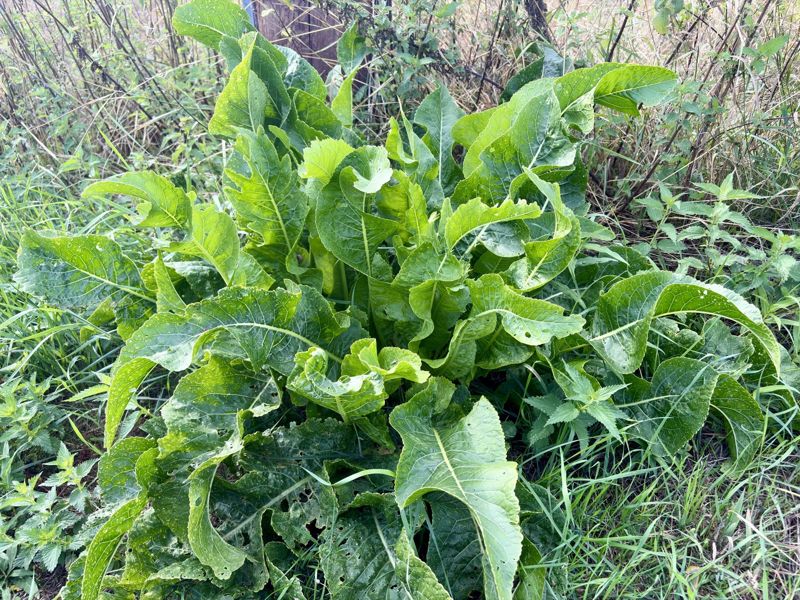
Horseradish (Armoracia rusticana) is a forb/herb that grows to about 1.5 feet tall and 1.5 feet wide.
To grow horseradish, give it full sun. It is hardy across USDA hardiness zones 3–9. Plant it in deep, rich, moist, well-drained soil, at a slightly acidic pH of 6–7.5. It does best with even, moderate watering.
Exact sowing, transplanting, and harvest months shift by climate zone — the planting calendar below lays them out for cool through hot regions. Its flowers appear from May through August, offering high value to pollinators. Food and forage in one stand — plant it where both you and the pollinators can reach.
Companion Planting & Soil
Horseradish grows well alongside potato and fruit trees.
Good Companions
Planting Calendar
When to sow, transplant, and harvest by growing zone.
| Zone | Action | Months | Notes |
|---|---|---|---|
| Cold (1-2) | Transplant | Apr — May | Plant root cuttings in early spring; choose site carefully — very hard to eradicate |
| Cold (1-2) | Harvest | Oct — Nov | Dig roots after first hard frost; pungency is strongest in fall |
| Cool (3-4) | Transplant | Mar — Apr | Plant root cuttings 3" deep, angled; perennial to zone 3 |
| Cool (3-4) | Harvest | Oct — Nov | Harvest in late fall after frost; grate immediately — volatile compounds fade fast |
| Moderate (5-7) | Transplant | Feb — Mar | Plant in late winter; grows in any soil; contain to prevent spreading |
| Moderate (5-7) | Harvest | Oct — Dec | Dig roots in fall; replant pencil-thick side roots for next year |
| Moderate (5-7) | Divide | Mar — Apr | Divide in spring; every root piece will grow a new plant |
| Warm (8-9) | Transplant | Jan — Feb | Plant in midwinter; needs some chill for best root development |
| Warm (8-9) | Harvest | Nov — Jan (wraps) | Harvest in late fall/winter after cool weather improves flavor |
| Hot (10+) | Transplant | Nov — Dec | Plant in fall; needs cool period to develop pungent roots |
| Hot (10+) | Harvest | Dec — Feb (wraps) | Harvest during coolest months |
Uses
In the Kitchen
In the kitchen, horseradish turns up in more than one form: freshly grated as a condiment for roast beef and smoked fish; mixed into cocktail sauce and Bloody Marys; horseradish cream sauce for prime rib.
Medicinal & Folk Use
In herbal and folk tradition, it has been valued in several ways: powerful sinus-clearing and decongestant action; antimicrobial compounds (isothiocyanates) support immune defense; traditional poultice for muscle and joint pain. These are traditional uses, not medical advice.
Beyond the Garden
Horseradish earns its keep past the plate, too: companion plant that may deter potato beetles; leaves used as a natural preservative in pickling.
Safety Notes
Root is extremely pungent; fumes can irritate eyes and nasal passages. Leaves are mildly toxic in large quantities.
The Field Library
Books from the Futurespore shelf that go deeper on plants like this one.
- The Modern Herbal Dispensatory a working reference for tinctures, salves, and doses once you get serious
- The Forager's Harvest identification, harvest windows, and preparation from someone who eats what he teaches
- Gaia's Garden home-scale permaculture — guilds, food forests, and beds that tend themselves
These are Bookshop.org affiliate links — they support independent bookstores and earn Futurespore a small commission at no extra cost to you. Browse the full Futurespore Bookshelf.