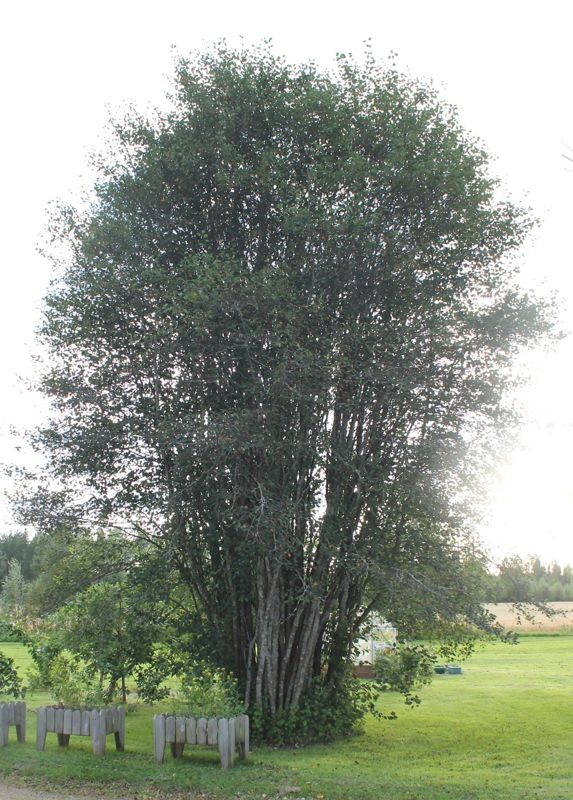
Serviceberry
Amelanchier spp.
Overview
A graceful native tree or shrub that offers four-season beauty — white spring blossoms, sweet summer berries, brilliant fall color, and elegant winter bark. Serviceberry fruit looks and tastes like a cross between blueberry and mild apple, and was an important food for Indigenous peoples across North America. It is one of the most versatile native edibles for home landscapes.
Growing Conditions
How to Grow Serviceberry
Serviceberry (Amelanchier spp.) is a shrub that grows to about 13 feet tall and 10 feet wide.
To grow serviceberry, give it partial sun to partial shade. It is hardy across USDA hardiness zones 2–7. Plant it in moist, well-drained, acidic to neutral soil; adaptable, at a slightly acidic pH of 5.5–7. It does best with even, moderate watering.
Exact sowing, transplanting, and harvest months shift by climate zone — the planting calendar below lays them out for cool through hot regions. Its flowers appear from March through May, offering high value to pollinators. It is a plant for the low-water garden — patient through heat, slow to complain.
Companion Planting & Soil
Serviceberry grows well alongside blueberry, aronia, elderberry, and clover.
Good Companions
Planting Calendar
When to sow, transplant, and harvest by growing zone.
| Zone | Action | Months | Notes |
|---|---|---|---|
| Cold (1-2) | Transplant | Apr — May | Plant in spring; extremely cold hardy; native understory tree; attracts birds |
| Cold (1-2) | Harvest | Jun — Jul | Harvest when berries turn dark purple; taste like blueberry-almond; net against birds |
| Cold (1-2) | Bloom | May — May | White flowers among earliest spring blooms; blooms before leaves emerge |
| Cold (1-2) | Prune | Mar — Apr | Prune suckers to maintain form; remove crossing branches after bloom |
| Cool (3-4) | Transplant | Mar — Apr | Plant in early spring; tolerates part shade; multi-stem or single-trunk forms |
| Cool (3-4) | Harvest | Jun — Jul | Pick when fully purple; eat fresh, bake, or make preserves |
| Cool (3-4) | Bloom | Apr — Apr | Profuse white flowers; critical early-season pollinator resource |
| Moderate (5-7) | Transplant | Mar — Apr | Plant in spring; adaptable to most soils; beautiful white spring bloom |
| Moderate (5-7) | Harvest | May — Jun | Harvest early summer; highly nutritious — higher antioxidants than blueberries |
| Moderate (5-7) | Bloom | Mar — Apr | Early spring bloom; ornamental and edible landscape tree |
| Warm (8-9) | Transplant | Feb — Mar | Plant in late winter; choose heat-tolerant species (A. arborea) |
| Warm (8-9) | Harvest | May — Jun | Harvest late spring; fruit production decreases in extreme heat |
Uses
In the Kitchen
In the kitchen, serviceberry turns up in more than one form: fresh eating — sweet, blueberry-almond flavor; pies, jams, and preserves; dried like raisins for baking and trail mix.
Medicinal & Folk Use
In herbal and folk tradition, it has been valued in several ways: high in anthocyanins and antioxidants like blueberries; rich in manganese, iron, and vitamin C; traditional tonic berry in Native American medicine. These are traditional uses, not medical advice.
Beyond the Garden
Serviceberry earns its keep past the plate, too: four-season ornamental native tree; critical early-season wildlife food source; edible landscaping and food forest understory tree.
The Field Library
Books from the Futurespore shelf that go deeper on plants like this one.
- Medicinal Herbs: A Beginner's Guide the friendliest on-ramp to growing and using healing herbs at home
- The Forager's Harvest identification, harvest windows, and preparation from someone who eats what he teaches
- Gaia's Garden home-scale permaculture — guilds, food forests, and beds that tend themselves
These are Bookshop.org affiliate links — they support independent bookstores and earn Futurespore a small commission at no extra cost to you. Browse the full Futurespore Bookshelf.